

The lowest-risk gateway into CEE e‑commerce
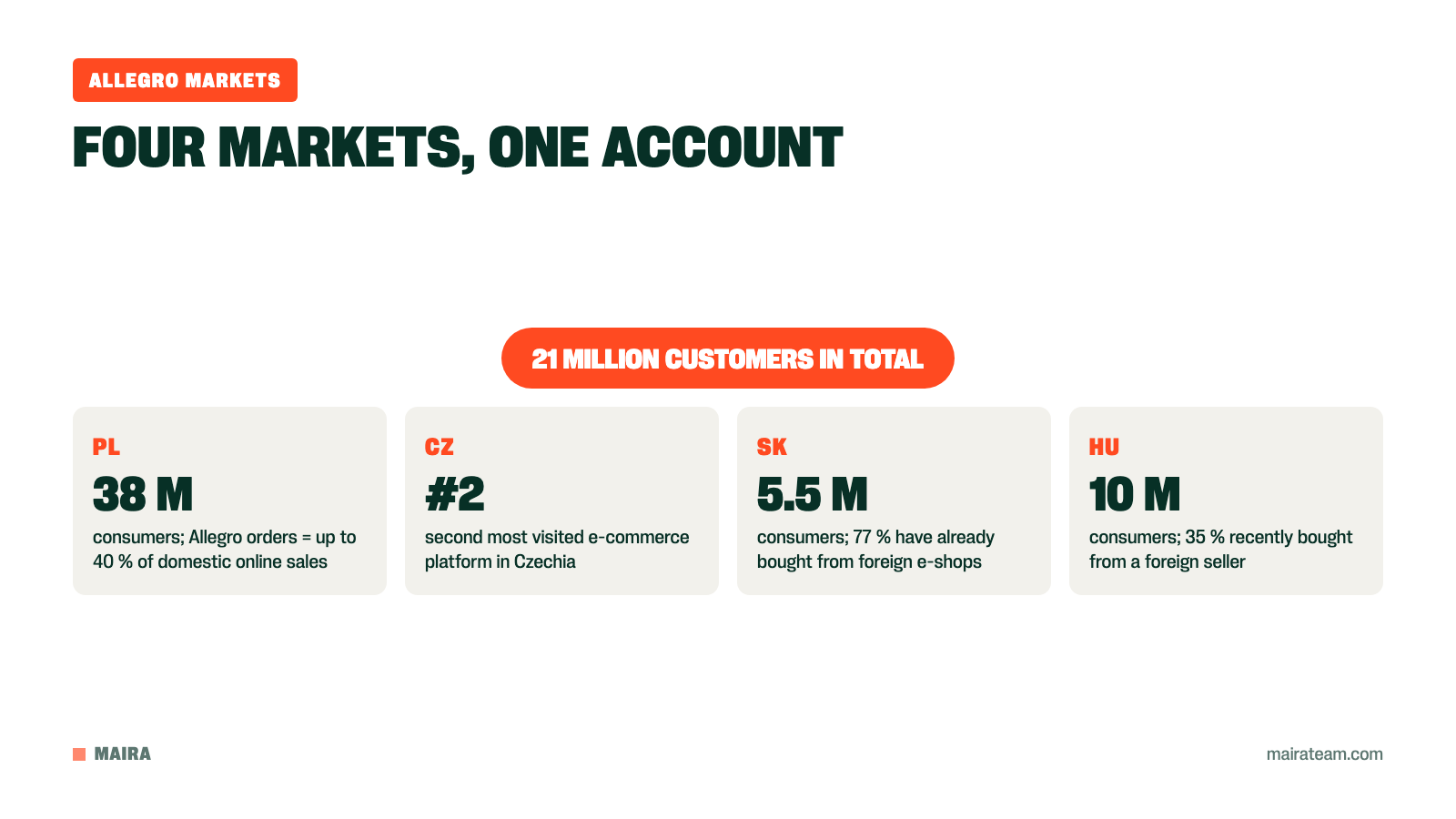
Allegro is the largest marketplace in Central Europe, with 21 million customers across Poland, Czechia, Slovakia, and Hungary. Registration is free, you pay a commission of roughly 4 to 15% only when you sell, and new sellers get a welcome program with 0% commission. One product feed covers all four markets, which makes Allegro the fastest gateway into CEE e‑commerce.
Allegro customers across PL, CZ, SK and HU
commission for new sellers in their first 180 days
sales commission depending on category
share of Allegro in Poland’s domestic online sales
If you sell in Western Europe and want growth beyond Amazon and bol.com, look east. Poland is the largest e-commerce market in Central Europe, and Allegro is its front door: orders on the platform account for up to 40% of Poland's domestic online sales. This guide comes from our internal go-to-market playbook and covers fees, registration, listings, Allegro Ads, and multi-market expansion with a single feed.
What is Allegro and why should sellers care?
Allegro is the dominant marketplace of Central and Eastern Europe, serving 21 million customers across Poland, Czechia, Slovakia, and Hungary. Sellers pay a commission only when an item sells, and creating an account is free. In Czechia, Allegro.cz has grown into the second most visited e-commerce platform by traffic.
Allegro has built consumer trust in Poland for over 25 years, comparable to what Amazon means in Germany or bol.com in the Netherlands. The group's GMV approached 70 billion PLN in 2025, and its international markets (Czechia, Slovakia, Hungary) grew GMV by double digits year over year (Allegro, 2026). For a Western brand, that is a large, fast-growing region reachable through one integration.
Allegro serves 21 million customers across Poland, Czechia, Slovakia, and Hungary, and orders on Allegro account for up to 40% of Poland's domestic online sales (Allegro, 2026).
How much does it cost to sell on Allegro?
Creating a seller account on Allegro is free and you pay a sales commission only when an item sells, roughly 4 to 15% depending on category (Allegro, 2026). New sellers get a welcome program with 0% commission: 180 days on the Czech, Slovak, and Hungarian marketplaces, 90 days in Poland. Testing the platform costs you nothing but setup time.
| Item | Allegro | Note |
|---|---|---|
| Account setup | 0 EUR | free registration |
| Listing fee | 0 EUR in most categories | you pay only on sale |
| Sales commission | approx. 4 to 15% | by category |
| Welcome program (CZ/SK/HU) | 0% commission for the first 180 days | new sellers |
| Welcome program (PL) | 0% commission for the first 90 days | new sellers |
| 0% export commission program | until December 31, 2026 | new offers on Allegro's international markets |
Source: Allegro pricing and help center, 2026.
On top of the welcome program, sellers registered on Allegro.cz, .sk, or .hu can join a 0% commission program for new export offers on Allegro's other markets, running until the end of 2026 (Allegro Help, 2026). The two programs cannot be combined, so pick the one that fits your stage.
New Allegro sellers pay 0% commission for their first 180 days (90 days in Poland); account creation and listings are free (Allegro, 2026).
Because commission applies only to completed sales, you never pay for traffic that does not convert. Factor cross-border shipping and returns into your margin model before scaling, and run your assortment through Allegro's official fee and commission calculator in the help center first: rates differ by category.
How does Allegro seller registration work?
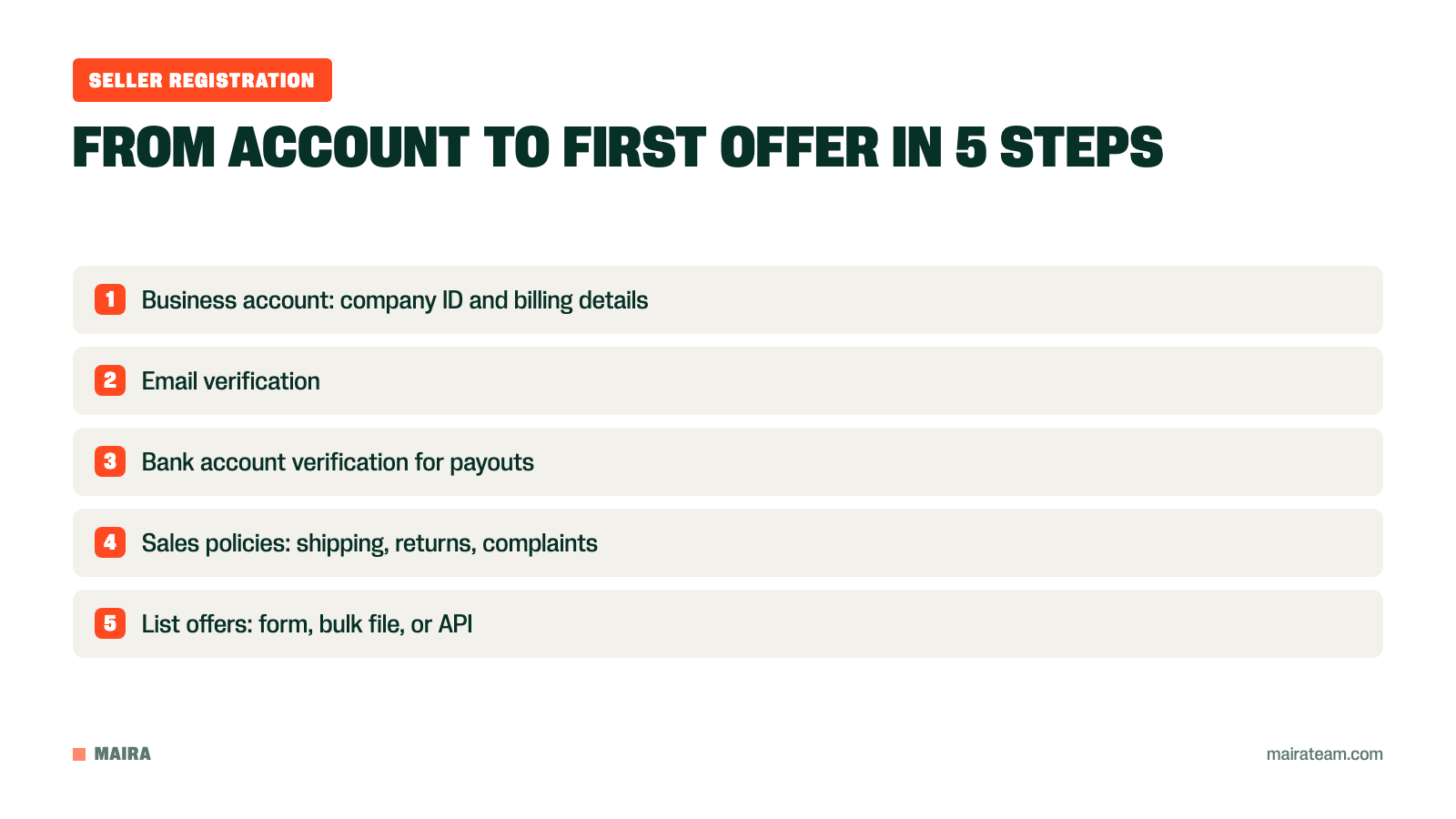
Registration takes 5 steps and is noticeably simpler than Amazon's process. You create a business account, verify your email and bank account, set your sales policies, and start listing. The whole process takes a few days, with bank account verification usually being the slowest step.
The registration flow:
- Create a business account. Company ID, billing details, contact person.
- Verify your email. Confirm the registration.
- Verify your bank account. Required for payouts from sales.
- Set your sales policies. Shipping, returns, complaints, terms of sale.
- List your offers. Via form, bulk file upload, or API.
How do you list products on Allegro?
There are three ways to get offers onto Allegro: a form for single offers, bulk upload from a file with up to 10,000 offers at once, or the Allegro API, which Allegro recommends for larger catalogs. The API connects Allegro to your shop system, warehouse, and accounting so orders flow automatically.
Options in practice:
- Single-offer form. For testing and small catalogs.
- Bulk file upload. Up to 10,000 offers in one import, useful for the initial catalog load.
- Allegro API. The recommended route: shop, warehouse, and accounting integration with automatic price and stock sync.
- Integration tools Base and Omnicado. They convert your existing feed into Allegro's format and handle order flow.
- Shoptet. E-shops on the Czech Shoptet platform get a direct connection: products, orders, and stock in one place.
Data quality decides visibility, the same as in Google Shopping: titles, parameters, and correct categories determine where buyers find you. MAIRA manages feeds with over 14 million SKUs, and the pattern is consistent: no ad budget fixes broken product data.
How does Allegro Ads work?
Allegro Ads offers two main formats. Sponsored offers run on a CPC model: you pay per click and your offer appears based on the phrase the buyer searches. Display ads run on a CPT model (cost per thousand impressions) on the homepage and above search results, currently only on Allegro.pl.
| Format | Payment model | Placement | Availability |
|---|---|---|---|
| Sponsored offers | CPC (per click) | search results matched to the buyer's phrase | all Allegro markets |
| Display ads | CPT (per thousand impressions) | homepage, above search results | Allegro.pl only |
Source: Allegro Ads, 2026.
Our recommended sequence from managed campaigns: organic first (strong offers, competitive price, fast delivery), then sponsored offers on your highest-margin assortment. A sponsored offer with an uncompetitive price only burns budget.
Allegro Ads is also part of the broader retail media wave in the region.
How do you expand across Poland, Czechia, Slovakia, and Hungary with one feed?
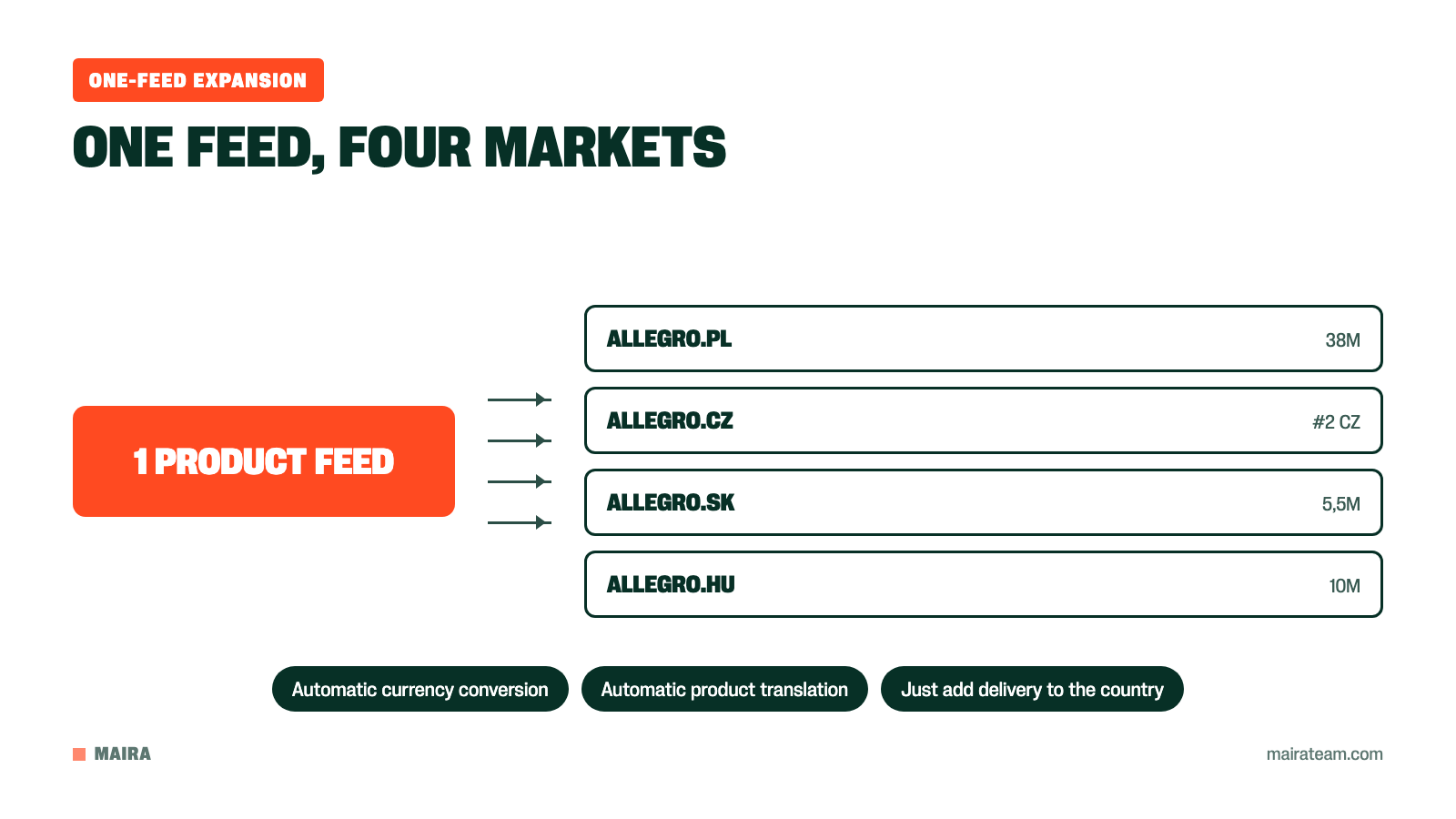
One feed covers all Allegro markets. You add delivery to the target country, and Allegro automatically converts currency and translates your product content. That makes Allegro the lowest-effort multi-market entry in CEE: one integration, four countries, no local entities required to start.
The market numbers:
- Poland: 38 million consumers, and orders on Allegro make up as much as 40% of domestic online sales. The region's largest e-commerce market and Allegro's home turf.
- Slovakia: almost 5.5 million consumers, 77% of whom have already bought from foreign e-shops. Fashion and home and garden lead the popular online categories. Highly open to cross-border sellers.
- Hungary: almost 10 million consumers, 35% of whom recently bought online from a foreign seller, most often electronics, home and garden, and fashion. Low competition from Western brands.
- Czechia: Allegro.cz is the second most visited e-commerce platform, a fast lane into a mature 40+ billion EUR CEE e-commerce region.
77% of Slovak consumers have already bought from foreign e-shops, and 35% of Hungarians recently bought online from a foreign seller (Allegro, 2026).
Marketplaces are the entry point, not the end state. The setups that win long term combine marketplaces with a local webshop and price comparison engines: marketplaces bring fast orders, owned channels keep margin and customer data.
When is Allegro worth it compared to Amazon and Kaufland?
Allegro is the right choice when Poland or CEE is your target: it owns local trust, entry is free, commission applies only on sale, and the 0% welcome program removes testing risk. For Western Europe, Amazon leads on reach. For Germany with lower seller competition, consider Kaufland Global Marketplace.
Think in channel roles, not platform loyalty. Amazon.pl exists, but Allegro dominates Polish e-commerce the way Amazon dominates Germany, so entering Poland without Allegro means competing against the default buying habit. Experienced sellers run Amazon for Western Europe, Kaufland for DACH, and Allegro for CEE, all fed from one product data source with market-specific pricing.
Tip: We handle data-driven expansion to new markets, including marketplaces like Allegro, as part of our international marketing service.
FAQ
How much does it cost to sell on Allegro?
Account creation and listings are free; you pay a commission only on completed sales, roughly 4 to 15% by category. New sellers get a welcome program with 0% commission for the first 180 days on the Czech, Slovak, and Hungarian marketplaces (90 days in Poland). No sale, no fee (Allegro, 2026).
Which countries does Allegro operate in?
Allegro runs marketplaces in Poland (allegro.pl), Czechia (allegro.cz), Slovakia (allegro.sk), and Hungary (allegro.hu), serving 21 million customers combined. One seller account and one feed cover all four markets, with automatic currency conversion and product translation.
Can international sellers join Allegro?
Yes. You register a business account, verify your email and bank account, set sales policies, and list. Allegro actively recruits international sellers and runs a 0% commission program for new export offers until the end of 2026. Local language customer service expectations and delivery times are the main operational hurdles.
How do I list products on Allegro technically?
Three ways: a single-offer form, bulk file upload with up to 10,000 offers at once, or the Allegro API, which is the recommended route for larger catalogs. Integration tools like Base and Omnicado convert existing feeds into Allegro's format and route orders back to your shop system.
How does Allegro Ads work?
Two formats. Sponsored offers are CPC: you pay per click and appear in search results matched to the buyer's phrase, available on all markets. Display ads are CPT (per thousand impressions) on the homepage and above search results, currently only on Allegro.pl. Start ads after your offers are organically competitive.
Do I need Polish translations for Allegro?
Not to start. Allegro translates product content automatically when you expand to another of its markets and converts currency as well. For your top sellers, review the automatic translation anyway: the offer title drives search visibility on the marketplace and machine errors cost sales and buyer trust.
Is Allegro or Amazon better for Poland?
Allegro. Orders on Allegro account for up to 40% of Poland's domestic online sales, and the platform has over 25 years of local consumer trust. Amazon.pl exists but holds a much smaller share of the market. For Western Europe the answer flips, which is why experienced sellers run both.
What is the Allegro welcome program?
A new-seller program with 0% sales commission: 180 days on the Czech, Slovak, and Hungarian marketplaces, 90 days in Poland. It lets you validate demand without commission costs. It cannot be combined with the 0% export commission program that runs until December 31, 2026 (Allegro Help, 2026).
Conclusion
Allegro is the lowest-risk entry into CEE e-commerce: free registration, 4 to 15% commission only on sale, a 0% welcome program, and one feed covering 21 million customers across four markets. Results come down to offer quality, market-specific pricing, and delivery speed. Want a plan that combines Allegro, Amazon, and Kaufland into one expansion strategy? Grab your free audit.

Marián Laššák
PPC Specialist
In the MAIRA team, I’m involved in performance marketing, from Google Ads and SA360 to comparison shopping. I like to try new approaches, test different tools and I enjoy the fact that in the PPC world there is always something new to discover.


