


One architecture, not three strategies
Answer engine optimization (AEO) means structuring your content so systems that return a single synthesized answer, such as AI Overviews, Google AI Mode, ChatGPT, Perplexity, and Copilot, can extract and cite it. It differs from SEO in the goal: you want to be the answer, not just the first link. It overlaps heavily with GEO. Answer-first structure, original numbers, and schema markup decide who gets cited.
YoY growth in answer engine optimization searches
of AI citations come from the first 30 % of a page
better conversion of AI referral traffic vs organic
days from publication to the first AI citation (median)
Three acronyms circle the same topic: SEO, AEO, and GEO. Plenty of marketing sites sell them as three separate disciplines that need three separate strategies. They are not, and this article explains why, what AEO actually covers, and what to do so answer engines pull their answers from your site. For the full playbook on AI citations, read our generative engine optimization guide. This article covers the terminology and the content layer.
What is answer engine optimization?
Answer engine optimization is the practice of shaping your content and technical setup so an answer engine can extract a direct, citable answer to a specific question from your pages. An answer engine responds to a query with one synthesized answer plus sources instead of a list of ten links.
Answer engines include AI Overviews and AI Mode in Google Search, ChatGPT, Perplexity, Microsoft Copilot, Gemini, and voice assistants. The term predates the current AI wave: it originally described optimizing for featured snippets and voice search. Today AEO effectively means writing content that AI systems can extract answers from.
Demand for the topic is growing at triple-digit rates. Searches for "answer engine optimization" grew 143 % year over year to 390 monthly searches across DACH and the Netherlands, and the German term "KI Suchmaschinenoptimierung" grew 215 % (Google Keyword Planner, 07/2026).
What is the difference between AEO, SEO, and GEO?
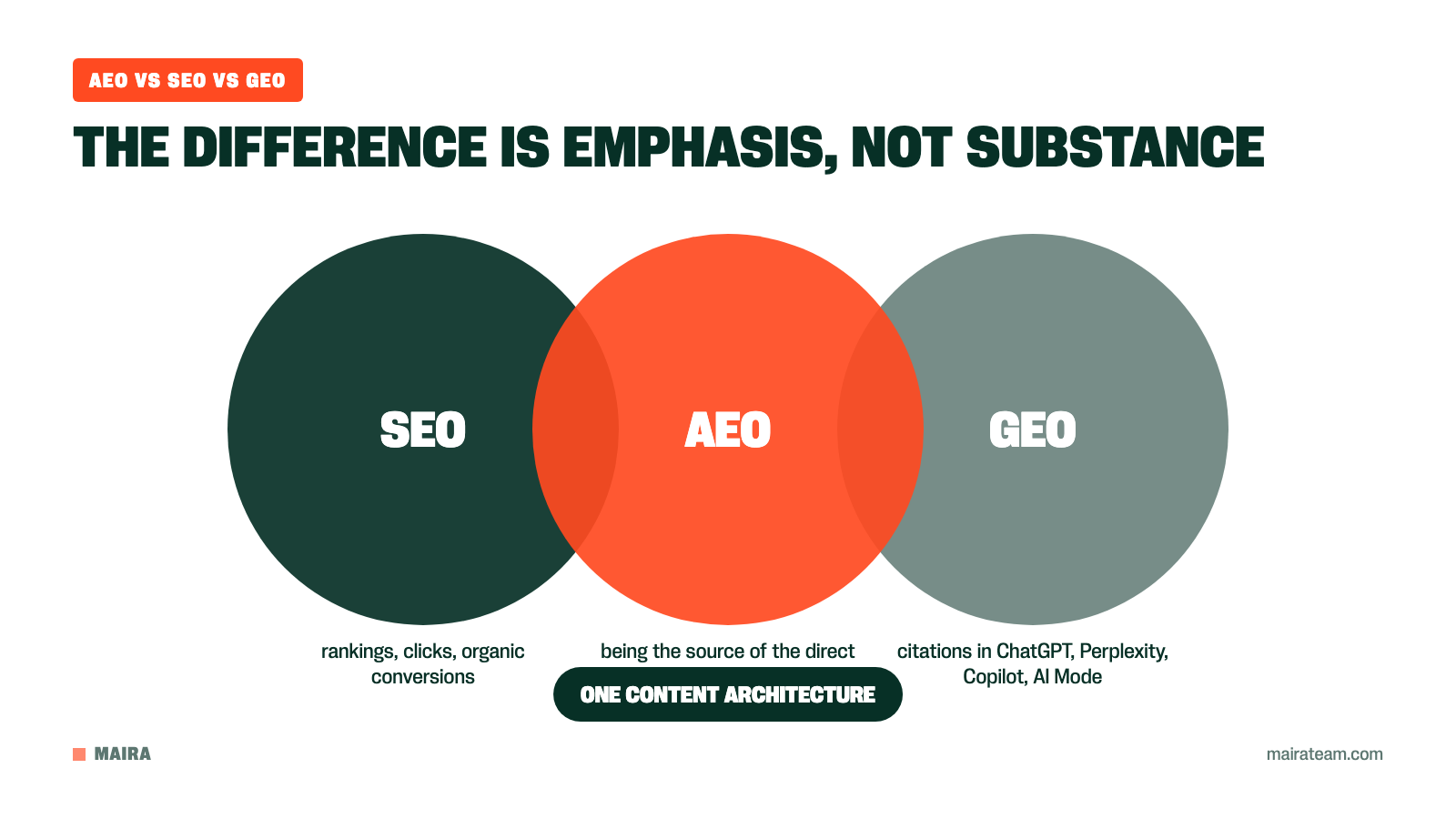
The difference is emphasis, not substance. SEO optimizes rankings in classic search, AEO optimizes content structure for direct answers, and GEO optimizes visibility in generative AI responses. In practice AEO and GEO overlap so much that most practitioners use them interchangeably. You do not need three strategies. You need one content architecture.
| Discipline | Goal | Where it plays out | Primary metric |
|---|---|---|---|
| SEO | rankings and organic traffic | Google, Bing | positions, clicks, organic conversions |
| AEO | being the source of the direct answer | featured snippets, AI Overviews, voice assistants, AI chats | share of answers on target queries |
| GEO | citations and mentions in generative answers | ChatGPT, Perplexity, Gemini, Copilot, AI Mode | citation count, AI referral traffic, brand mentions |
The practical split we use: AEO is the content layer (writing so an answer can be extracted), GEO adds the distribution and technical layer (third-party mentions, AI crawlers, Bing, schema). SEO remains the foundation of both, because AI systems still source most citation candidates through classic search indexes.
One important exception to that rule: 83 % of AI Overview citations come from pages outside the organic top 10, and roughly 80 % of URLs cited by ChatGPT are not in Google's top 100 (Semrush and related studies, 2025). AI citations are partly a separate game, and a challenger site can win it without winning the classic SERP first.
Why does AEO matter right now?
Because demand and impact are both growing faster than the competition. Search interest in AEO and adjacent terms is up triple digits on every market we track, AI referral traffic converts far better than organic, and most brands still have zero footprint in AI answers. Whoever becomes the answer source first tends to get cited repeatedly.
| Term | Market | Searches/mo | YoY growth |
|---|---|---|---|
| answer engine optimization | EN (DACH+NL) | 390 | +143 % |
| ai search optimization | EN (DACH+NL) | 210 | +193 % |
| ki suchmaschinenoptimierung | DE (DACH) | 110 | +215 % |
| answer engine optimization aeo | EN | growing from a low base | new term |
Source: Google Keyword Planner, 07/2026.
Three numbers summarize the business case:
- AI referral traffic is still around 1 % of visits for most sites, but it converts 4.4x to 23x better than organic; ChatGPT referrals reach conversion rates around 7.1 % (industry analyses, 2025 to 2026).
- 73 % of brands ranking on page one of Google have zero mentions in AI answers. The field is wide open, including in German-speaking markets where content competition is thinner than in English.
- The median time from publication to first AI citation is roughly 6.8 days for content indexed in Bing. The feedback loop is faster than classic SEO.
What do answer engines actually cite?
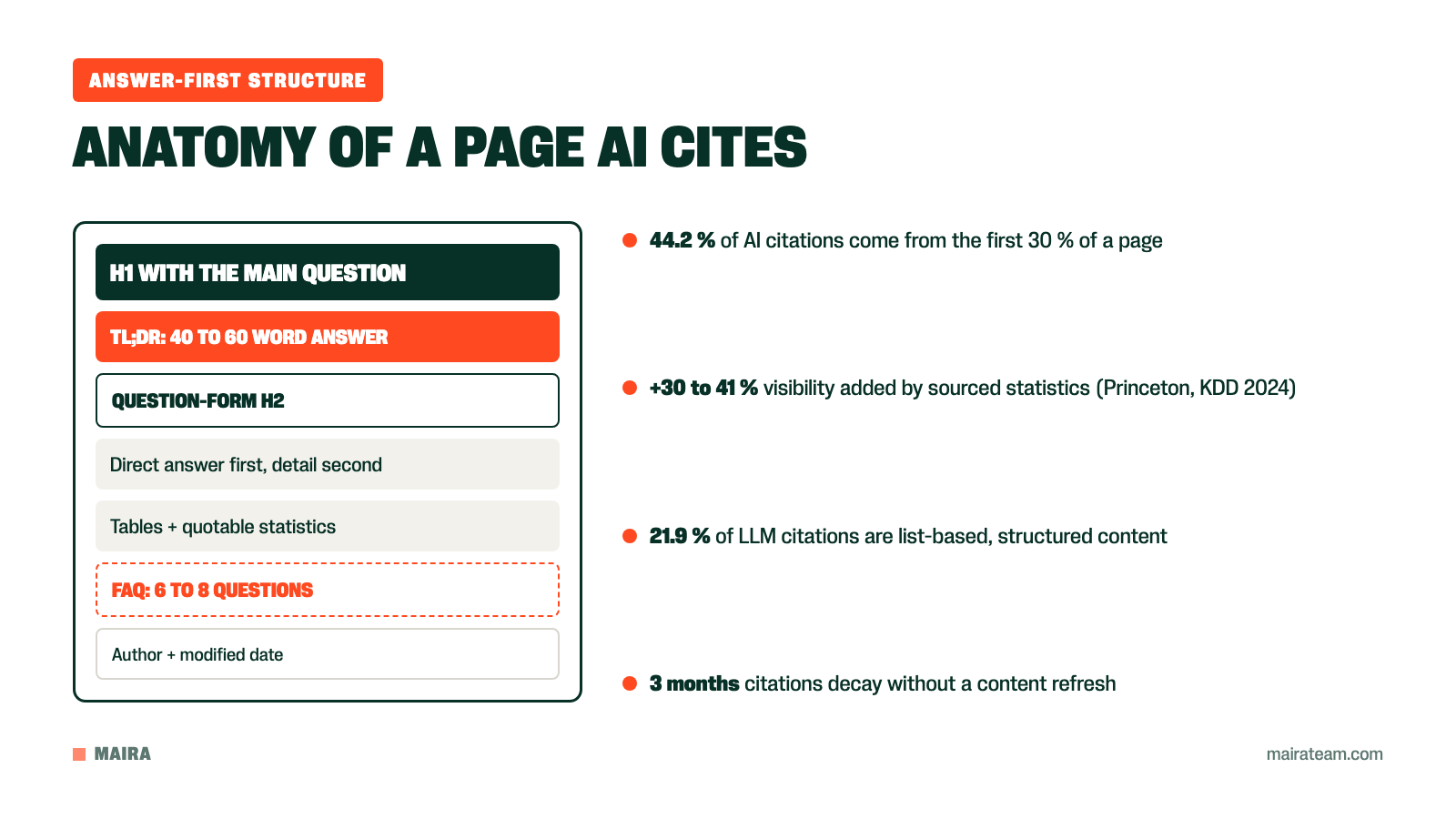
They cite content an answer can be lifted from without effort: direct answers right under the heading, specific statistics with sources, tables, lists, and fresh data. The strongest quantified finding: adding statistics, source citations, and expert quotes lifts visibility in AI answers by 30 to 41 % (Princeton and Georgia Tech, KDD 2024).
What the available studies say about citation selection:
- Answer-first passages win. 44.2 % of citations come from the first 30 % of a page. The answer belongs at the top, not in the conclusion.
- Structure beats prose. Listicles account for 21.9 % of LLM citations, and roughly 80 % of cited pages use lists or other strong structure.
- Numbers with sources are magnets. A standalone sentence with a statistic and a source can be quoted without context, and that is exactly how AI systems use it.
- Freshness matters. 65 % of AI bot hits go to content younger than one year, and citations decay after about three months. Evergreen content needs scheduled refreshes and a visible modified date.
- Authorship and trust. A named author with a role and bio improves citation odds on queries where the AI chooses between similar sources.
What does an answer-first page look like?
Every important page answers one main question and several secondary ones. You answer the main question in 40 to 60 words directly under the H1, turn secondary questions into question-form H2s, and put a direct answer under each of them. Detail, tables, and examples come after.
The answer-first page checklist:
- The H1 contains the main query or its natural phrasing.
- A TL;DR block with a 40 to 60 word direct answer sits right under the H1.
- H2s are phrased as questions people actually ask.
- Under every H2: answer first, detail second.
- At least two tables with data that does not exist elsewhere.
- At least three independently quotable sentences with a statistic and source.
- An FAQ section with 6 to 8 questions and answers under 80 words.
- A named author with a role, plus visible published and modified dates.
This article follows that exact checklist. Answer-first structure is not theory; it is the template we use for all of our content.
What technical setup does AEO require?
The content layer is not enough if AI systems cannot reach it. The technical minimum: allow AI crawlers in robots.txt, keep key content in plain HTML with no JavaScript dependency, deploy schema markup, and cover Bing, which is the data backbone of ChatGPT.
- Robots.txt: allow GPTBot, OAI-SearchBot, ClaudeBot, PerplexityBot, Google-Extended, and Bingbot. Verify actual crawls in your server logs.
- No JavaScript-dependent content: OpenAI's crawlers do not render JavaScript. Your numbers and key claims must live in raw HTML.
- Schema markup: Organization, Article with author and dates, and FAQPage. Vendor studies report roughly 2.5x higher inclusion odds in AI answers; treat that as a cheap measure with a likely upside, not a guaranteed factor.
- Bing Webmaster Tools and IndexNow: roughly 87 % of ChatGPT Search citations match Bing top results. A site not indexed in Bing effectively does not exist for ChatGPT.
- llms.txt: deploy it, but keep expectations low. Ahrefs (06/2026) found 97 % of llms.txt files received zero requests. Details in our llms.txt guide.
For e-commerce, the technical layer includes product data: conversational attributes in Merchant Center are AEO for your product feed.
How do you measure AEO results?
Start with Bing Webmaster Tools, currently the only tool that shows how often Microsoft Copilot cites your site. Add an AI referral segment in GA4 and a monthly prompt monitoring routine in ChatGPT, Perplexity, and Gemini: ask your customers' questions and record who gets cited.
The measurement stack in practice:
- Bing Webmaster Tools, AI Performance section: how often Copilot cites your site in its answers, tracked monthly.
- GA4: a segment for referrals from chatgpt.com, perplexity.ai, gemini.google.com, and copilot.microsoft.com. On mairateam.com, AI referrals currently account for around 3 % of visits and the share keeps growing.
- Prompt monitoring: 20 to 30 questions covering your business, tested monthly with identical wording.
- Google Search Console: AI Overviews show up indirectly, typically as rising impressions with flat clicks on informational queries.
The 10-step AEO checklist
- Pick 10 to 20 questions you want to be the answer to. Start from customer questions, not just keyword tools.
- Assign one target page per question. One page, one main question.
- Rebuild those pages answer-first: TL;DR, question-form H2s, a direct answer under each.
- Add original data: your own numbers, benchmarks, results. Original statistics are the strongest citation factor.
- Add tables and lists wherever they carry information.
- Add an FAQ section and FAQPage schema to every key page.
- Name the author with a role and show the last modified date, both also in Article schema.
- Allow AI crawlers, verify content renders in raw HTML, register in Bing Webmaster Tools, enable IndexNow.
- Set up measurement: BWT AI Performance, a GA4 AI referral segment, prompt monitoring.
- Refresh key content at least quarterly. Citations decay without freshness.
Tip: What performance marketing is, how to measure it and when it makes sense, we cover on our performance marketing page.
Frequently asked questions
Is AEO the same as GEO?
In practice, yes. Both describe optimizing for visibility in AI answers, and most tactics overlap. AEO emphasizes content structure (being an extractable answer), GEO emphasizes citations and distribution (mentions, crawlers, Bing, schema). GEO is the faster-growing term in Europe, which is why we use it as the umbrella label in our content.
Does AEO replace classic SEO?
No. AI systems still source most of their answer candidates through classic search indexes, so without indexation and decent rankings there is nothing to optimize. AEO builds on SEO: it adds the structure and data that turn visible content into a cited answer. Budget-wise it extends existing work rather than adding a new line item.
How fast do results show up?
Faster than classic SEO. The median time from publication to first AI citation is about 6.8 days for content indexed in Bing. A realistic horizon for a measurable shift in citation counts and AI referrals is 2 to 3 months, because you need to restructure multiple pages and wait for recrawling.
Do I need to rewrite my whole site for AEO?
No. Start with the 10 to 20 pages that answer your customers' highest-value questions: services, pricing, comparisons, how-tos. Rebuild those answer-first and add FAQs. Handle the rest during regular content updates. Rewriting everything without prioritization is the most expensive possible route.
Which schema markup matters most for AEO?
FAQPage, Article, and Organization. FAQPage hands AI systems ready-made question and answer pairs, Article supplies the author and published and modified dates, Organization anchors your company as an entity. Schema is not a guaranteed AI ranking factor, but it is cheap, risk-free, and vendor data links it to significantly higher inclusion odds.
Does AEO work for e-commerce?
Yes, on two layers. Content: buying guides and comparisons built answer-first, because shopping queries in AI chats keep growing. Data: a product feed with conversational attributes in Merchant Center so AI shopping surfaces understand your products. A store missing either layer will be invisible in AI-driven shopping.
How do I find out whether AI assistants cite me?
Three ways. Bing Webmaster Tools shows Copilot citation counts directly. GA4 reveals visits from chatgpt.com, perplexity.ai, and other AI referrers. And manual prompt monitoring: a fixed set of 20 to 30 customer questions tested monthly shows who the AI names for your topics and how that changes.
Conclusion
AEO, GEO, and SEO are not three strategies. They are one architecture: content built as an answer, backed by original data, and technically accessible to AI systems. Deploy it early and answer engines will cite you, and citations tend to compound. Want to know where your site stands in AI answers? Get a free audit and we will measure your citations, structure, and technical base, then tell you straight.

Jan Křelina
PPC Specialist
At Proficio I handle PPC and META advertising for our clients across Europe. I love it when I see positive results of my work and when I manage to take my client’s online marketing one step further. I love learning new things and platforms and I’m really enjoying the combination of PPC advertising and AI agents. In my spare time I like to travel, watch soap operas or hole up in the spa.


