


A third source of performance, not a replacement
Criteo earns its place in 2026 for stores with large catalogs, roughly 3,000 EUR or more in monthly channel budget, and a need for performance outside the Google and Meta duopoly. Its edge: deterministic commerce data, controllable dynamic retargeting, and a direct line into European retail media. Small accounts with narrow catalogs should consolidate into PMax and Advantage+ instead.
retailers and premium publishers in Criteo Commerce Max
minimum viable monthly Criteo budget
growth of European retail media spend in 2024
weeks, typical Criteo learning phase
Performance Max and Meta Advantage+ absorb most European e-commerce budgets today. So the real question is not "Criteo or Google and Meta" but "what does Criteo do that the other two cannot". MAIRA is a Criteo Partner and we run Criteo campaigns across European markets, including for Knuspr, the German arm of Rohlik Group. This is the decision guide we wish existed when clients ask us that question.
What is Criteo and how does it work in 2026?
Criteo is a commerce media platform: it buys display and native inventory across the open web and retailer sites, and targets based on shopping behavior rather than demographics. The core is deep learning bidding built on your product feed plus a commerce dataset that neither Google nor Meta can see. It stopped being "just that retargeting banner company" years ago.
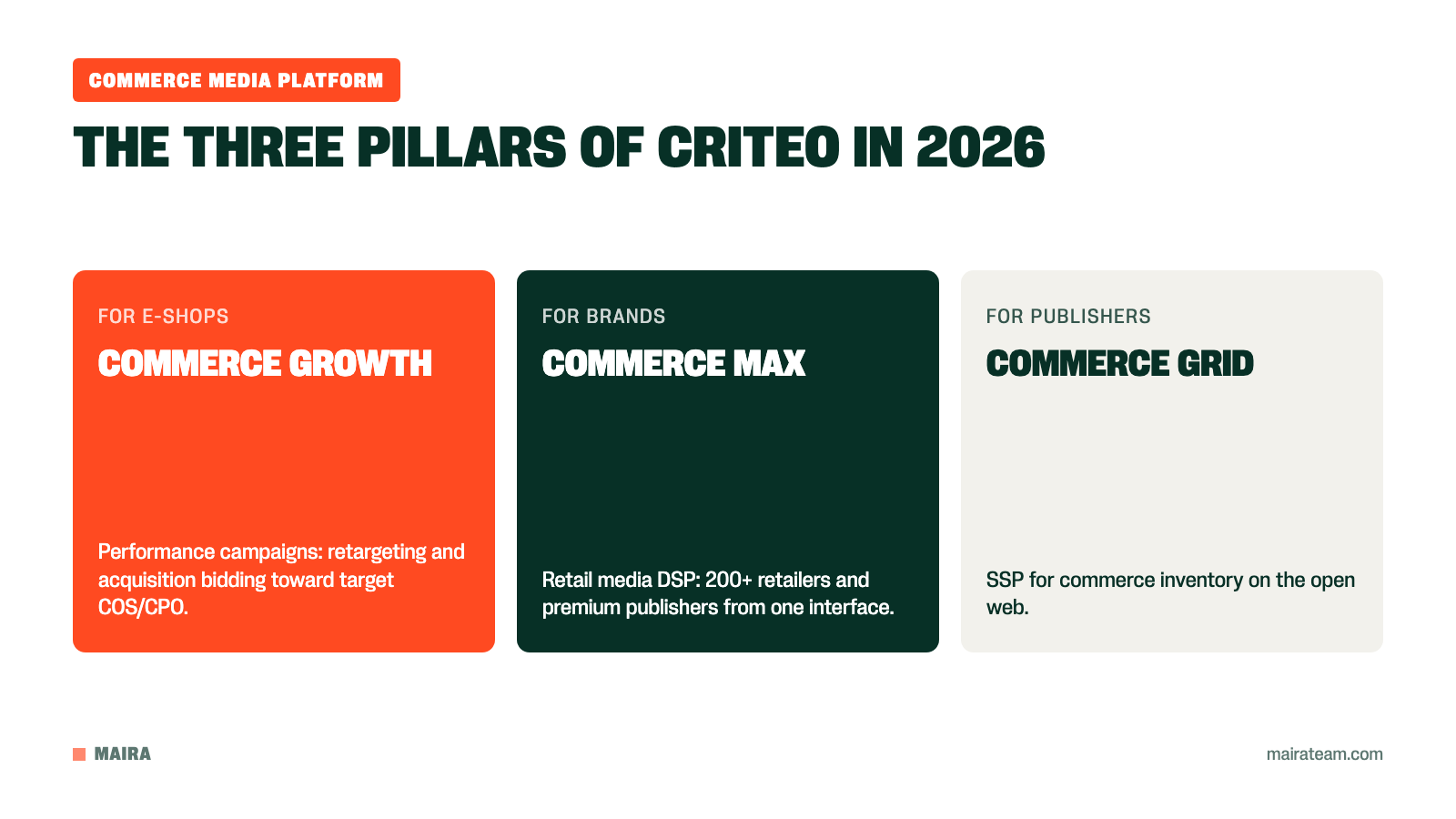
Criteo reports reach of roughly 2.5 billion shoppers and visibility into more than 1 trillion USD in yearly commerce transactions (Criteo, 2026). The platform now rests on three pillars:
- Commerce Growth: performance campaigns for online stores (retargeting plus new customer acquisition) with automated bidding toward a target COS or CPO.
- Commerce Max: a demand-side platform for buying retail media inventory across more than 200 retailers and premium publishers.
- Commerce Grid: a supply-side platform for commerce inventory on the open web.
For a typical store, Commerce Growth is the entry point.
Search demand for criteo remains stable in Europe: 2,900 monthly searches in English across DACH and the Netherlands, plus 1,900 in German (Google Keyword Planner, 07/2026). The platform has not disappeared from consideration sets. What changed is the role it plays in the mix.
When does Criteo make sense next to Performance Max and Advantage+?
Criteo makes sense when you need a third independent source of performance: incremental reach beyond Google and Meta properties, deterministic commerce data for targeting, and dynamic retargeting with deeper product-level control than PMax offers. It does not make sense as a replacement for PMax or Advantage+, only as an addition once those two saturate.
The three platforms do three different jobs:
| Criterion | Criteo | Performance Max | Meta Advantage+ |
|---|---|---|---|
| Primary job | Retargeting + acquisition via commerce data | Capturing existing demand (search, shopping) | Creating new demand in social feeds |
| Data source | Deterministic purchase data from retailer network | Google search intent + own signals | Social graph + engagement signals |
| Inventory | Open web, publishers, retailers (OTTO, bol.com class partners) | Search, Shopping, YouTube, Display, Gmail | Facebook, Instagram, Audience Network |
| Product-level control | High (feed rules, product logic) | Low (black box asset groups) | Medium (catalog sets) |
| Typical ramp-up | 2 to 4 weeks of learning | 4 to 6 weeks of learning | 1 to 3 weeks of learning |
| Minimum viable spend | ~3,000 EUR/mo | From hundreds of EUR/mo | From hundreds of EUR/mo |
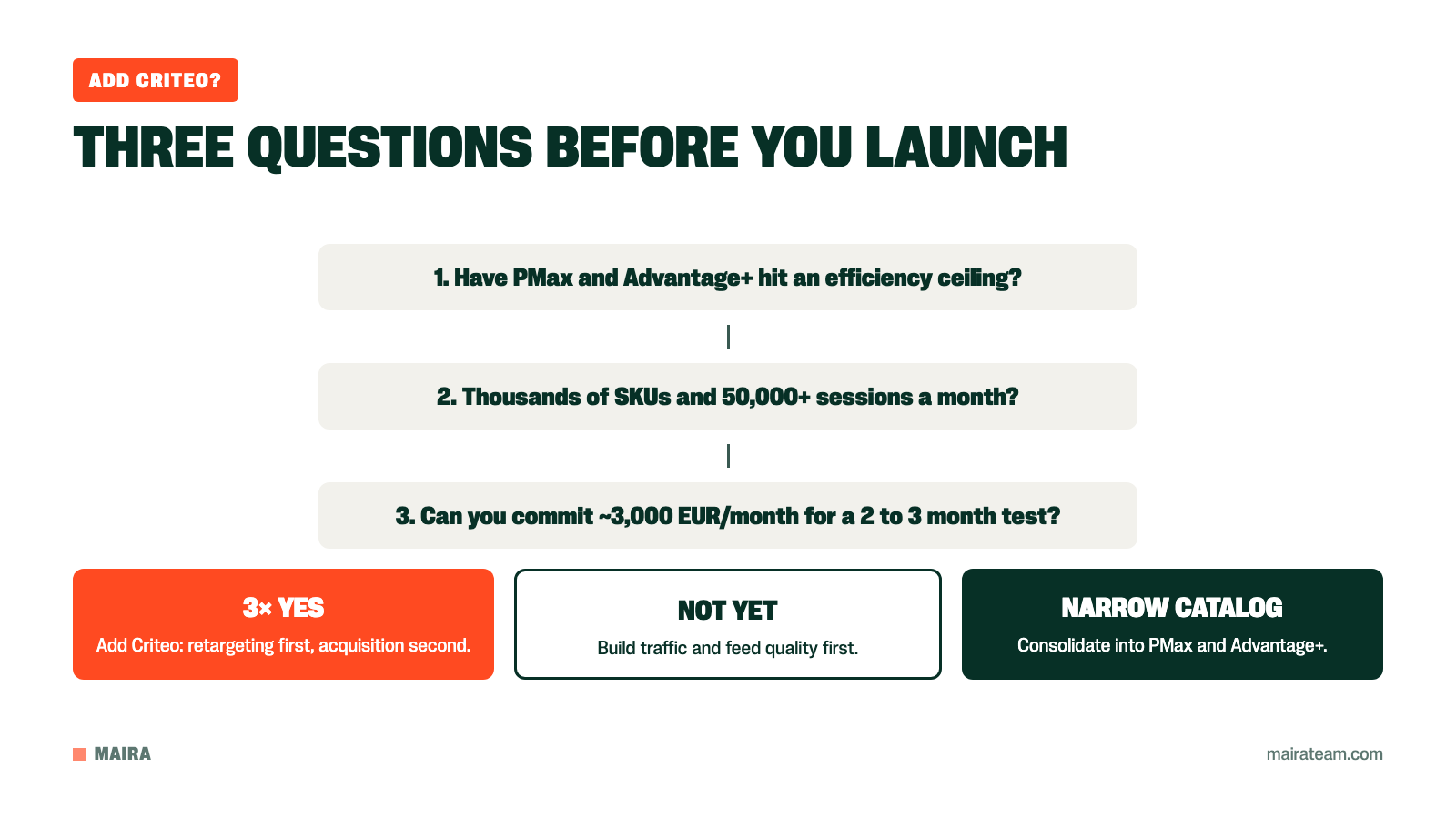
Our working rule: as long as PMax and Advantage+ have not hit an efficiency ceiling (CPA climbing as you push budget), do not add a third platform. Once they have, Criteo is the first candidate for e-commerce, because it works with data the other two do not have.
Which stores should run Criteo?
Criteo performs best for stores with thousands of SKUs, repeat purchase behavior, and enough traffic to build retargeting pools. The strongest verticals in our accounts: fashion, home and living, online grocery, and consumer electronics. For narrow catalogs under a hundred products or low-traffic sites, the investment rarely pays back.
| Store type | Criteo in the mix | Recommended approach |
|---|---|---|
| Fashion, thousands of SKUs, high purchase frequency | Yes, retargeting + acquisition | Full setup including lookalike commerce audiences |
| Electronics, higher basket, longer consideration | Yes, retargeting first | Longer windows, test acquisition second |
| Online grocery, fast reorder cycles | Yes, retention + retargeting | Connect to retail media (see Knuspr below) |
| Marketplace-heavy sellers (Amazon, Kaufland, bol.com) | Partly | Prioritize retail media on the marketplace, Criteo on your own store |
| Narrow catalog under 100 SKUs | Usually no | Consolidate into PMax + Advantage+ |
| Under ~50,000 sessions/mo | Not yet | Build traffic first, then retargeting |
Two preconditions always apply. First, a clean product feed: Criteo builds both creatives and bidding from it, and feed errors kill performance exactly as they do in PMax. Second, honest measurement, which we cover next.
How much budget should Criteo get?
In accounts where Criteo belongs, it typically stabilizes at roughly 10 to 15 % of the performance budget. The exact share depends on how saturated your other channels are and on your margins. Start with a 2 to 3 month test budget and scale based on incrementality, never on the platform's own attributed ROAS.
The rollout sequence we use:
- Month 0: feed audit, measurement setup (GA4 plus server-side), target COS definition.
- Months 1 to 2: retargeting campaign with enough budget to learn, no bidding changes for the first 14 days.
- Months 2 to 3: evaluation against a holdout group or geo-lift test, not against last-click attribution.
- Month 3+: add new customer acquisition campaigns, scale on incremental CPA.
How do you measure Criteo's real contribution?
Never judge Criteo by post-view conversions in its own reporting. Retargeting platforms structurally overstate their contribution, because they reach users who would have completed part of those purchases anyway. The right approach: unify measurement in GA4, read both numbers side by side, and base big decisions on incrementality tests.
Measurement checklist:
- Connect Criteo to GA4 and compare both reports side by side.
- Exclude or heavily discount post-view conversions when evaluating.
- Run a holdout or geo-lift test on retargeting once per quarter.
- Track new customer share, not just blended COS.
We measure retargeting incrementality with DiagnostIQ, our in-house testing framework. The general pattern is consistent: part of the reported performance would happen anyway, yet properly configured dynamic retargeting stays incremental. How to squeeze the most out of it: boost your dynamic remarketing conversion rate by up to 200%.
How does Criteo fit into a retail media strategy?
Criteo is the largest independent retail media technology in Europe, and that makes it a strategic choice rather than just another retargeting vendor. Through Commerce Max you buy sponsored placements and display across dozens of European retailers from one interface, using the same feed and similar logic as your performance campaigns.
European retail media spend grew 21.1% to 13.7 billion EUR in 2024, and IAB Europe forecasts 20.8 billion EUR for 2026 (IAB Europe, 2025). For brands selling through retailers and their own store, Criteo is the natural bridge between the two worlds: one platform, one feed, two inventory types.
Working with Knuspr, we see both sides of the market: Rohlik Group operates its own retail media offering while also buying performance media. That combination is where Criteo accounts are heading: performance campaigns for your own store plus retail media wherever your buyers already shop.
What are the most common Criteo mistakes?
The most common mistake is launching Criteo as "one more retargeting tool" with a messy feed, no incrementality measurement, and a budget too small for the algorithm to learn. The second most common: judging the platform after two weeks based on its own dashboard.
- Test budgets too small, campaigns killed mid-learning phase.
- Post-view conversions treated as real performance.
- Duplicate retargeting: Criteo, Meta, and PMax chasing the same user with no frequency caps.
- Neglected feed: missing GTINs, wrong categories, images unusable in banners.
- No exclusion of existing customers in acquisition campaigns.
- Meta campaigns managed through Criteo without understanding the differences (guide: Meta campaigns in Criteo).
Tip: Criteo is one of the channels we manage as part of paid media. See how we work on our PPC agency page.
FAQ
Is Criteo dead in 2026?
No. Criteo transformed from a retargeting network into a commerce media platform with its own DSP and SSP. Brand search demand is stable (2,900 monthly EN searches across DACH and NL, Google Keyword Planner, 07/2026), and the company is Europe's largest independent retail media player. Its role changed: complement to PMax and Meta, not a replacement.
What is the minimum budget for Criteo?
From our accounts, roughly 3,000 EUR per month for Criteo alone. Below that, the algorithm learns slowly and results swing. Smaller stores get better outcomes by consolidating budget into Performance Max and Meta Advantage+, which work at lower spend levels.
Does Criteo work without third-party cookies?
Yes, better than most display networks. Criteo builds on deterministic first-party data from its retailer network, hashed emails, and its own identity graph. Commerce audiences and contextual signals cover the gap cookies left. Retargeting performance dipped after cookie restrictions but the channel remains viable.
Does Performance Max replace Criteo retargeting?
They overlap partially, but you cannot control PMax retargeting: Google does not show how much budget hits new versus returning users. Criteo gives explicit control over retargeting share, frequency, and product logic. Large-catalog stores typically run both, with clearly split roles and frequency caps.
How long until Criteo starts performing?
The learning phase takes 2 to 4 weeks depending on conversion volume. Do not touch bidding for the first 14 days. A fair evaluation is possible after 6 to 8 weeks, ideally against a holdout. Switching Criteo off after two weeks of weak numbers is the most common avoidable mistake.
What is Commerce Max and do I need it?
Commerce Max is Criteo's DSP for retail media: sponsored products and display across more than 200 retailers from one interface. It matters most for brands selling through retailers (grocery, drugstore, electronics). A pure D2C store can stick with Commerce Growth campaigns for its own site.
Why do Criteo and GA4 numbers never match?
They never will match one to one: Criteo counts post-click and post-view, GA4 counts sessions with its own attribution. Read both side by side, steer by the GA4 trend and incrementality tests, and treat the platform dashboard as an optimization signal, not as truth.
Can Criteo acquire new customers, or is it retargeting only?
It can. Acquisition campaigns target users whose shopping behavior across the retailer network resembles your buyers. They work best after a solid retargeting foundation and with existing customers excluded. Expect a higher CPA than retargeting and judge them by new customer share.
Conclusion
Criteo in 2026 is not a competitor to PMax and Advantage+ but a third source of performance built on data Google and Meta do not have. It pays off for stores with broad catalogs, sufficient traffic, and budgets from a few thousand EUR per month, and it must be judged on incrementality, not on its own dashboard. Want to know how much performance you are leaving on the table? Grab a free audit and we will walk through your account together.

Filip Lorenz
PPC Specialist
I’m a performance marketer, and in the PPC world I’m always looking for ways to do things smarter and more efficiently, so I focus on automating everything that can be automated and trying to make AI part of my daily work.


