Sell on Amazon Europe: the 2026 guide for e‑shops
How to sell on Amazon Europe: fees, Seller Central registration, FBM vs FBA, and Amazon Ads. A practical go-to-market guide for e‑commerce brands.

One account, 10 European markets, 450 million customers
To sell on Amazon Europe, register in Seller Central and pick a plan: Professional costs 39 EUR per month excluding VAT and covers every European Amazon store with one fee. On top of that you pay a referral fee, usually 8 to 15% of the total price including shipping, by category. One account reaches over 450 million potential customers in the EU.
potential customers reached with one seller account
per month for the Professional plan, all markets included
typical referral fee by category
EUR in 2024 revenue on Amazon.de, the largest Amazon market outside the US
Amazon is the most popular marketplace in Europe. For an e-commerce brand it is the fastest route to customers in Germany, France, or the Netherlands without building a local webshop first. This guide is based on our internal go-to-market playbook: fees, registration step by step, the FBM vs FBA decision, listings that convert, and Amazon Ads. By the end you will know whether Amazon fits your unit economics and what to do first.
Why sell on Amazon in Europe?
Amazon Europe reaches over 450 million potential customers, and a single seller account covers all European Amazon stores: Germany, the UK, France, Italy, Spain, the Netherlands, Sweden, Poland, Belgium, and Ireland. You manage listings, inventory, and orders from one Seller Central interface, which makes it the widest single entry point into European e-commerce.
The engine is Amazon.de. Germany is Amazon's largest market outside the US, generating 40.9 billion EUR in revenue in 2024 (hellotax, 2026). If DACH is your expansion target, Amazon belongs in the channel mix next to marketplaces like Kaufland and OTTO.
One Amazon seller account covers 10 European marketplaces and reaches over 450 million potential customers in the EU (Amazon Seller Central, 2026).

How much does it cost to sell on Amazon Europe?
Selling on Amazon costs a subscription plus a referral fee per sale. The Professional plan is 39 EUR per month excluding VAT, one fee for all European stores. The Individual plan charges 0.99 EUR per item sold and only makes sense below 40 units per month. Referral fees mostly run 8 to 15% of the total price including shipping, by category.
| Item | Professional | Individual |
|---|---|---|
| Monthly fee | 39 EUR excl. VAT | 0 EUR |
| Per-item fee | 0 EUR | 0.99 EUR |
| Market coverage | all European stores, one fee | all European stores |
| Makes sense from | 40+ units sold per month | under 40 units per month |
| Amazon Ads access | yes | limited |
Source: Amazon Seller Central pricing, 2026.
Referral fees are identical on both plans. Amazon also cut fees for selected low-priced items from January 2026: clothing and accessories up to 15 EUR dropped from 8 to 5%, home products up to 20 EUR from 15 to 8%, and grocery plus supplements up to 10 EUR from 8 to 5% (About Amazon, 2026).
Amazon referral fees in most categories run between 8 and 15% of the total sales price including shipping; in January 2026 Amazon reduced fees on selected low-priced items (About Amazon, 2026).
Before you commit, model the unit economics per product in the Revenue Calculator inside Seller Central. It compares your own fulfillment (FBM) against Fulfillment by Amazon (FBA) on one screen, including storage and handling fees.
How does Amazon Seller Central registration work?
Registration takes 9 steps and a few days if your company documents and VAT details are ready. Identity and business verification is the slowest part, and Amazon enforces it strictly. You cannot publish offers until verification is complete.
- Create a Seller Central account. Email, phone, payment card.
- Verify your identity and business. ID document, company registration extract, bank account.
- Provide VAT details. Required for markets where you store inventory or cross sales thresholds.
- Choose a selling plan. Professional (39 EUR/month) or Individual (0.99 EUR/item).
- Select marketplaces. Activate the stores you want; one account covers all of them.
- Create listings. Manually, via CSV, via API, or through third-party tools.
- Choose fulfillment. FBM (you ship) or FBA (Amazon stores and ships).
- Brand Registry (optional). Brand protection and enhanced content, requires a registered trademark.
- Publish offers. Review, go live, and connect orders back to your e-shop.
FBM or FBA: which fulfillment model should you pick?
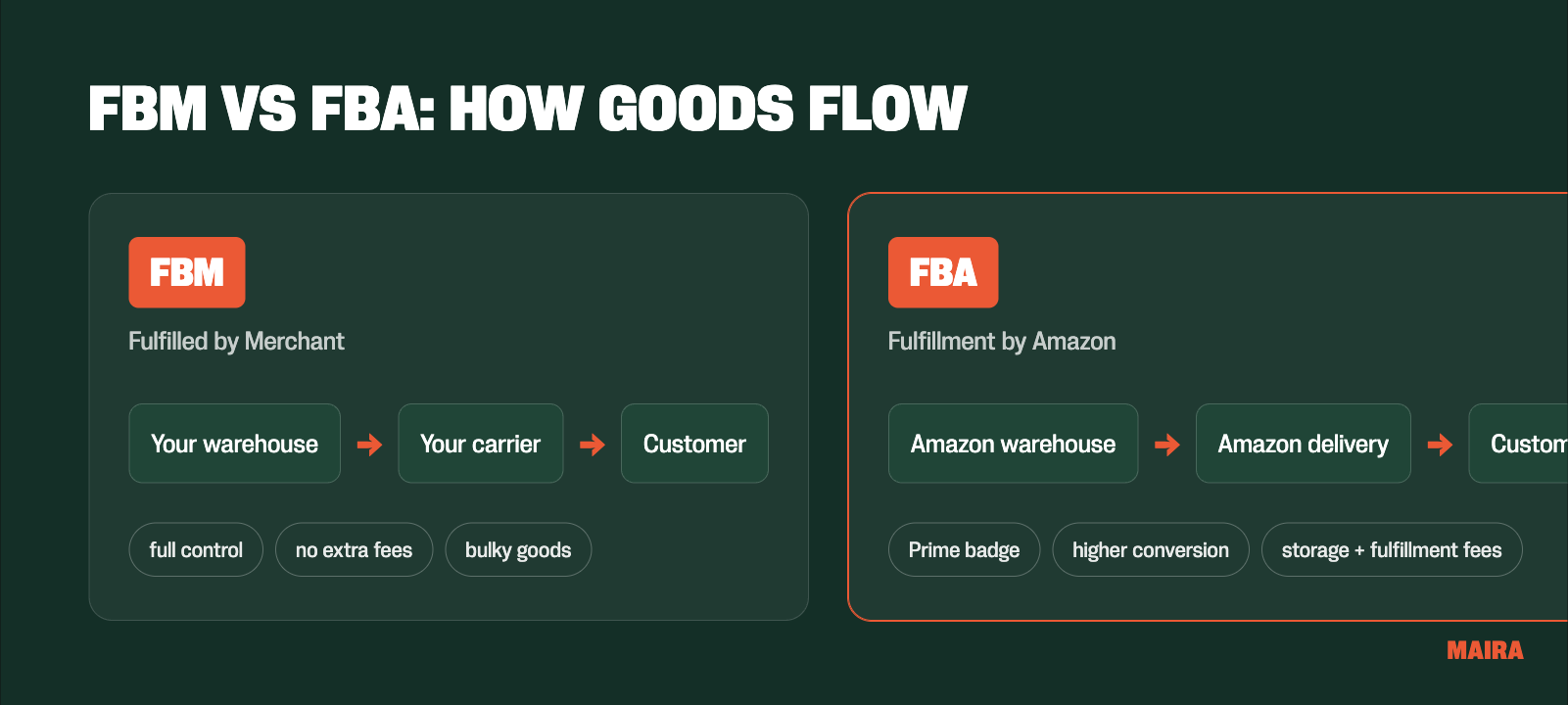
FBM (Fulfilled by Merchant) means you store and ship orders yourself. FBA (Fulfillment by Amazon) means you send stock to Amazon's warehouses and Amazon handles delivery, customer service, and returns, while your products earn the Prime badge. FBA lifts conversion rates but adds storage and fulfillment fees.
| Criterion | FBM | FBA |
|---|---|---|
| Storage | your warehouse | Amazon warehouse |
| Delivery | you ship | Amazon ships |
| Customer service and returns | you handle | Amazon handles |
| Prime badge | usually no | yes |
| Extra fees | none | storage + fulfillment fees |
| Process control | full | limited |
| Best for | heavy or bulky goods, testing | fast movers, scaling |
Do not decide on gut feel. Run both models through the Revenue Calculator per product: cheap fast movers usually win with FBA thanks to Prime, bulky and heavy items with FBM. A common setup is hybrid: FBA for the top sellers, FBM for the long tail.
How do you build listings that convert?
The product detail page is where the purchase decision happens. Title, bullet points, photos, and reviews drive conversion, and accurate descriptions reduce returns because customers get exactly what they expected. You can upload listings manually, via CSV, via API, or through third-party tools such as Base or Expando.
- A title with key parameters. Brand, product, variant, key attribute. The title is the main search ranking factor on the marketplace.
- Bullet points. Five benefit-led, specific bullets. No filler.
- Photos. Clean pack shots on white plus lifestyle images and size infographics.
- An accurate description. Materials, dimensions, compatibility. Inaccuracy means returns and bad reviews.
- Correct category and attributes. They determine your referral fee rate and where shoppers find you.
Listing data is the same discipline as your Google product feed: data errors kill performance before ads even enter the picture. For multi-country expansion, use Build International Listings: it automatically translates offers into each marketplace's language and syncs prices. Always review machine translation on your top sellers, because the title decides whether shoppers find you at all.
How does Amazon Ads work?
Amazon Ads runs on a CPC model: you pay per click and ads appear in search results, on product pages, in the Amazon app, and on third-party sites. Sponsored Products is the core format, pushing specific offers to top positions. Without ads, a new seller in a competitive category grows slowly.
Practical rules from the campaigns we manage:
- start with an automatic Sponsored Products campaign on your top sellers to harvest search terms,
- move winning terms into manual campaigns with your own bids,
- judge ACOS against real product margin, not revenue,
- scale ads only after listings are fixed; advertising cannot save a weak product page.
Amazon Ads is also the largest retail media network in the world, so the skills transfer directly to other retailers' media programs.
What should you expect in regulated categories? A cosmetics example
In regulated categories, plan for extra approvals. A model case from our practice: a cosmetics brand needed CPNP certificates (the EU cosmetics notification) before selling, and Amazon's category approval took 7 to 14 business days. Without the paperwork, Amazon will not publish the offers.
How the setup looked:
- product data flowed into Amazon as an XML feed through the Base integration tool,
- category mapping got extra attention, since it drives both fees and approval,
- shipping, claims, and returns policies were configured directly in Seller Central,
- orders were routed back into the e-shop so inventory and accounting stayed in one system.
The lesson: in regulated categories (cosmetics, food, supplements, electronics with batteries), start with compliance documents, not listings. It saves weeks of waiting.
When is Amazon worth it, and when should you pick another marketplace?
Amazon is worth it if your prices are competitive, your margins survive an 8 to 15% referral fee plus logistics, and you can handle strict platform rules. If you want a lower barrier of entry into Germany, consider Kaufland Global Marketplace first. For Poland and CEE, the first choice is Allegro. In the Netherlands, bol.com is the local incumbent worth testing alongside Amazon.nl.
Amazon offers the biggest reach and the strongest logistics (FBA), but also the hardest competition, the strictest rules, and rivalry with Amazon's own retail offers. Experienced sellers usually end up multi-marketplace: Amazon for Western Europe, Kaufland for DACH with lower competition, Allegro for CEE. And never make marketplaces your only channel: combining them with your own e-shop keeps margin and customer data in your hands.
Germany is Amazon's largest market outside the US, with 40.9 billion EUR in revenue in 2024 (hellotax, 2026).
FAQ
How much does it cost to sell on Amazon Europe?
The Professional plan costs 39 EUR per month excluding VAT and covers all European Amazon stores with one fee. The Individual plan charges 0.99 EUR per item and suits sellers below 40 units per month. On top, you pay a referral fee, usually 8 to 15% of the total price including shipping, depending on category (Amazon, 2026).
Which European marketplaces does Amazon operate?
Amazon runs European stores in Germany, the UK, France, Italy, Spain, the Netherlands, Sweden, Poland, Belgium, and Ireland. You manage all of them from one Seller Central account, and the Professional plan covers them with a single monthly fee. Germany is the largest market by far.
Is FBM or FBA better?
It depends on your assortment. FBA (Amazon stores and ships) earns the Prime badge and higher conversion but adds storage and fulfillment fees. FBM (you ship) gives full control and wins on bulky goods. Model both in the Revenue Calculator and feel free to combine them across your catalog.
How long does Amazon registration take?
Creating the account takes about an hour; identity and business verification takes days to weeks depending on document quality. In regulated categories, add category approval time: for cosmetics with CPNP certificates, expect 7 to 14 business days before offers go live.
Do I need translations for each Amazon marketplace?
Yes, every marketplace requires local-language content. Build International Listings translates offers automatically and syncs prices across markets. Still, review machine translation on your top sellers: the product title is the main search factor on the marketplace and errors in it cost sales.
How do I get products onto Amazon technically?
Four ways: manually one by one, in bulk via CSV templates, via API, or through third-party tools like Base and Expando that convert your existing feed into Amazon's format and route orders back to your shop. For catalogs beyond a few hundred SKUs, use a tool or the API.
Should I run Amazon Ads from day one?
Turn on Sponsored Products early, because a new seller without reviews or history barely sells organically. The precondition is finished product pages: ads cannot fix a weak listing, they only make it more expensive. Start with an automatic campaign on top sellers and manage ACOS against margin.
Is Amazon or Kaufland better for entering Germany?
Amazon has the biggest reach and FBA logistics but extreme competition and strict rules. Kaufland has lower seller competition, simpler terms, and one account covering 9 markets, which makes it the easier first step. Experienced sellers usually run both at the same time.
Conclusion
Selling on Amazon Europe is a craft, not a lottery: 39 EUR per month for the Professional plan, 8 to 15% referral fees, nine registration steps, and an FBM vs FBA decision based on real unit economics. Success comes from listing quality, pricing, and data discipline, not from how fast you register. Want to know whether your assortment can win on Amazon and how to combine marketplaces with your own channels? Grab your free audit.

Marián Laššák
PPC Specialist
In the MAIRA team, I’m involved in performance marketing, from Google Ads and SA360 to comparison shopping. I like to try new approaches, test different tools and I enjoy the fact that in the PPC world there is always something new to discover.