ChatGPT ads in Europe: how they work and how to start
ChatGPT ads went live across 31 European countries in August 2026. Formats, pricing, contextual targeting and what to prepare before your first campaign.

A new channel: prepare now, test with discipline
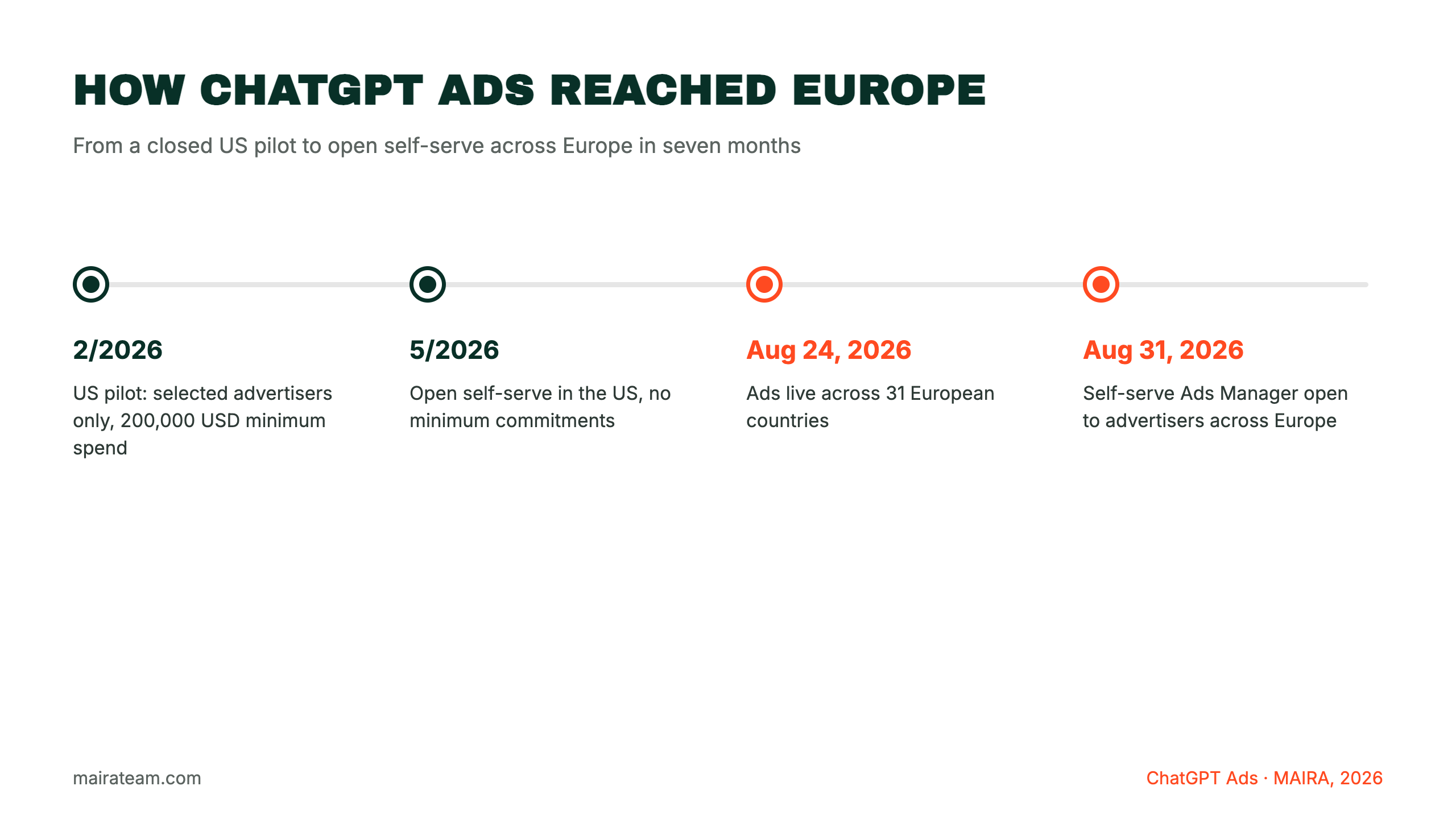
Since August 24, 2026, ads in ChatGPT have been shown to users across 31 European countries. They appear as a sponsored card below the answer, run on cost per click and target the context of the conversation instead of keywords. Since August 31, 2026, the self-serve OpenAI Ads Manager is open to businesses across Europe. If you want to be early, sort out your account, measurement and product feed now. If you would rather have the launch run for you, see our ChatGPT Ads agency service.
Update, September 1, 2026: On August 31, 2026 OpenAI opened the self-serve Ads Manager across Europe and announced that its ads business reached a 1 billion USD annual run rate. The article has been updated accordingly.
launch of ads across 31 European countries
countries worldwide where ChatGPT Ads run (OpenAI, 8/2026)
of ChatGPT prompts carry commercial intent (Digiday, 08/2026)
the self-serve Ads Manager opens to advertisers across Europe
What are ChatGPT ads and what do they look like?
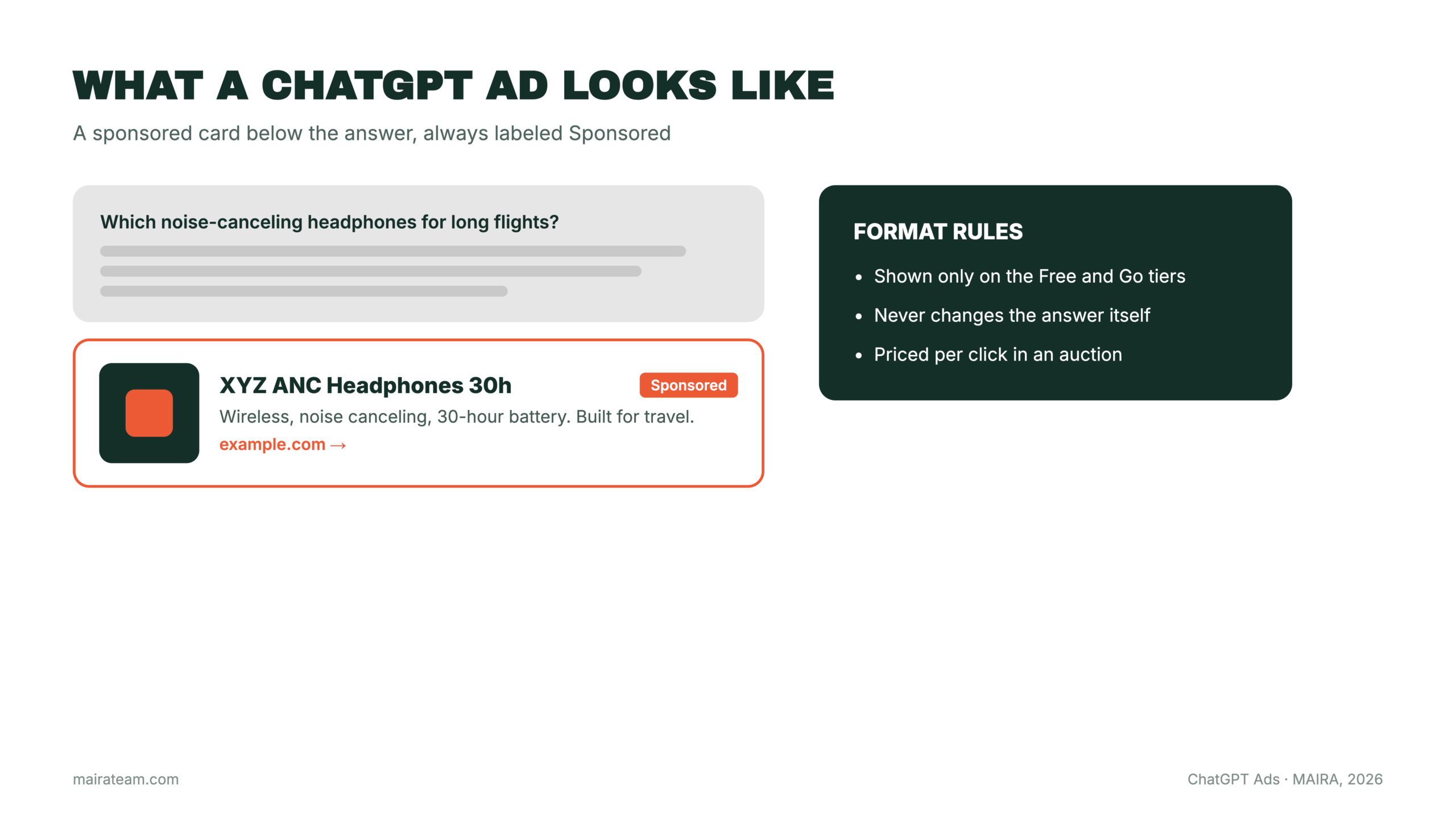
A ChatGPT ad is a sponsored card shown below the assistant's answer when the topic of the conversation matches the advertiser's targeting. The card carries a headline, a short description, a square image and a link. It is always labeled Sponsored and it never changes the answer itself.
That is the fundamental difference from search advertising. The ad is not tied to a typed query but to the whole conversation: someone is asking, comparing options, working through a decision. The ad arrives at the decision moment, not the search moment. For e-commerce, the system can also surface a recommended product from your feed, which makes the card behave like a Shopping ad inside a conversation.
ChatGPT counts more than one billion weekly users, and roughly 20 percent of prompts carry commercial intent (OpenAI and Digiday, August 2026).
Who sees the ads and where do they run?
Only users on the Free tier and the low-cost Go tier see ads. Subscribers on Plus, Pro, Business, Enterprise and Edu see none, and neither do users under 18. The state of play:
| Parameter | Status (September 2026) |
|---|---|
| Who sees ads | Free and Go tiers; paid tiers and under-18 accounts do not |
| Where ads run | US (since February 2026), UK, Canada, Australia, Japan and more; since August 24, 2026 in 31 European countries |
| Who can advertise | The self-serve Ads Manager runs in 48 countries worldwide; open to advertisers across Europe since August 31, 2026 |
| Format | A sponsored card below the answer; product recommendations from a feed for e-commerce |
| Targeting | Contextual signals, no keywords; no personalization in the EU at launch |
| Pricing | Auction-based, CPC and CPM with conversion optimization; no minimum commitments, minimum daily budget depends on the account currency |
The European launch has one specific trait: at launch, the EU version does not target chat history or personal profiles. Ad selection uses only the topic of the current conversation, approximate location, device, language and time of day. Personalized ads require explicit opt-in consent (Digiday, August 2026). Sensitive topics such as health or politics stay ad-free.
How does targeting work without keywords?
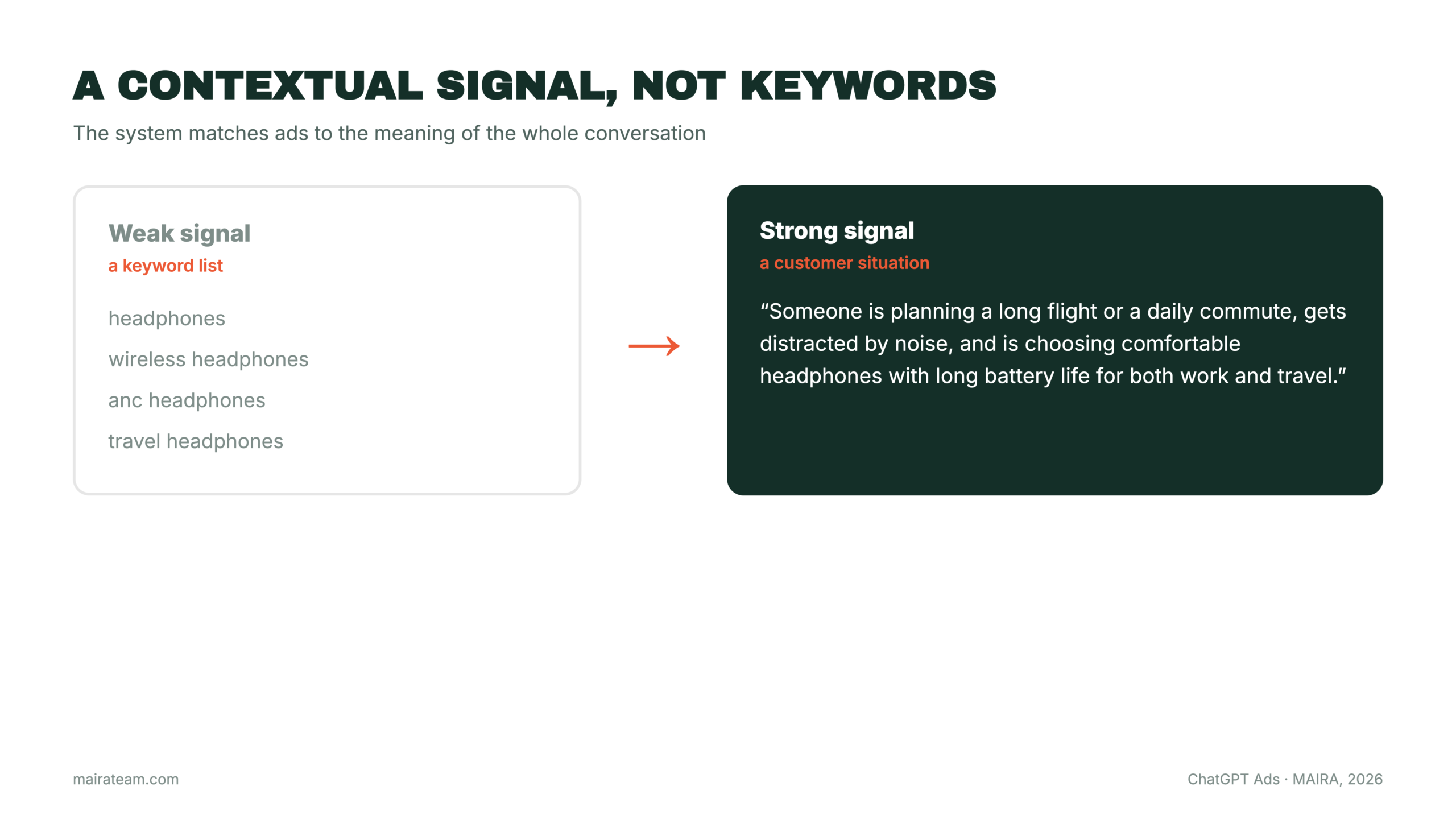
Targeting runs on contextual signals. Instead of a keyword list, the advertiser describes the situation in which the offer should appear: who is solving what problem, at what moment, and why this product is the answer. The system then matches the ad semantically against the meaning of the whole conversation.
Two practical consequences:
- A weak signal is a rewritten keyword list. A strong signal is a description of a customer situation.
- One ad group should cover one type of intent. Purchase, comparison and research conversations behave differently; mixing them makes results unreadable.
A signal is a hint, not a rule. It does not guarantee delivery, and advertisers cannot see which conversations triggered their ads; there is no equivalent of the search terms report from Google Ads. You can exclude custom audiences, such as existing customers via hashed emails; negative contextual signals do not exist yet. Factor that into your evaluation.
What do you need before launch?
You cannot launch this through an agency in a few clicks. Every advertiser needs:
- Their own OpenAI Ads Manager account and business verification through the Persona service (restricted industries get extended review).
- Mind the locks: country, currency and timezone lock permanently after account creation. A mistake means starting over.
- A payment card issued to the same company and country the account is verified for. A mismatch is the most common reason verification fails. The model where an agency pays and re-invoices media does not work here.
- Measurement in place (pixel, ideally the Conversions API too) and, for e-commerce, a product feed.
The agency then works through shared access to your account, not ownership. Same principle as Meta's Business Manager: the account and the data belong to the advertiser. This is how our ChatGPT Ads agency setup works too.
How do you measure results?
OpenAI offers two paths that are meant to be combined:
- The browser pixel: a JavaScript snippet on your site. Easy to deploy, but exposed to blockers and cookie consent. In the EU it must be wired into your consent management platform.
- The Conversions API: server-to-server, more reliable, more work to implement.
The recommended standard is both at once, deduplicated through a shared event ID. OpenAI also supports third-party measurement integrations. The default attribution window is 7 days post click and 1 day post view. Your pixel ID only exists once the account does, so prepare the implementation upfront and drop the ID in later.
One practical detail that gets forgotten: separate paid ChatGPT traffic from organic ChatGPT referrals with UTM parameters from day one. Otherwise the two merge into a single source in GA4 and the channel cannot be evaluated.
How do you prepare the product feed?
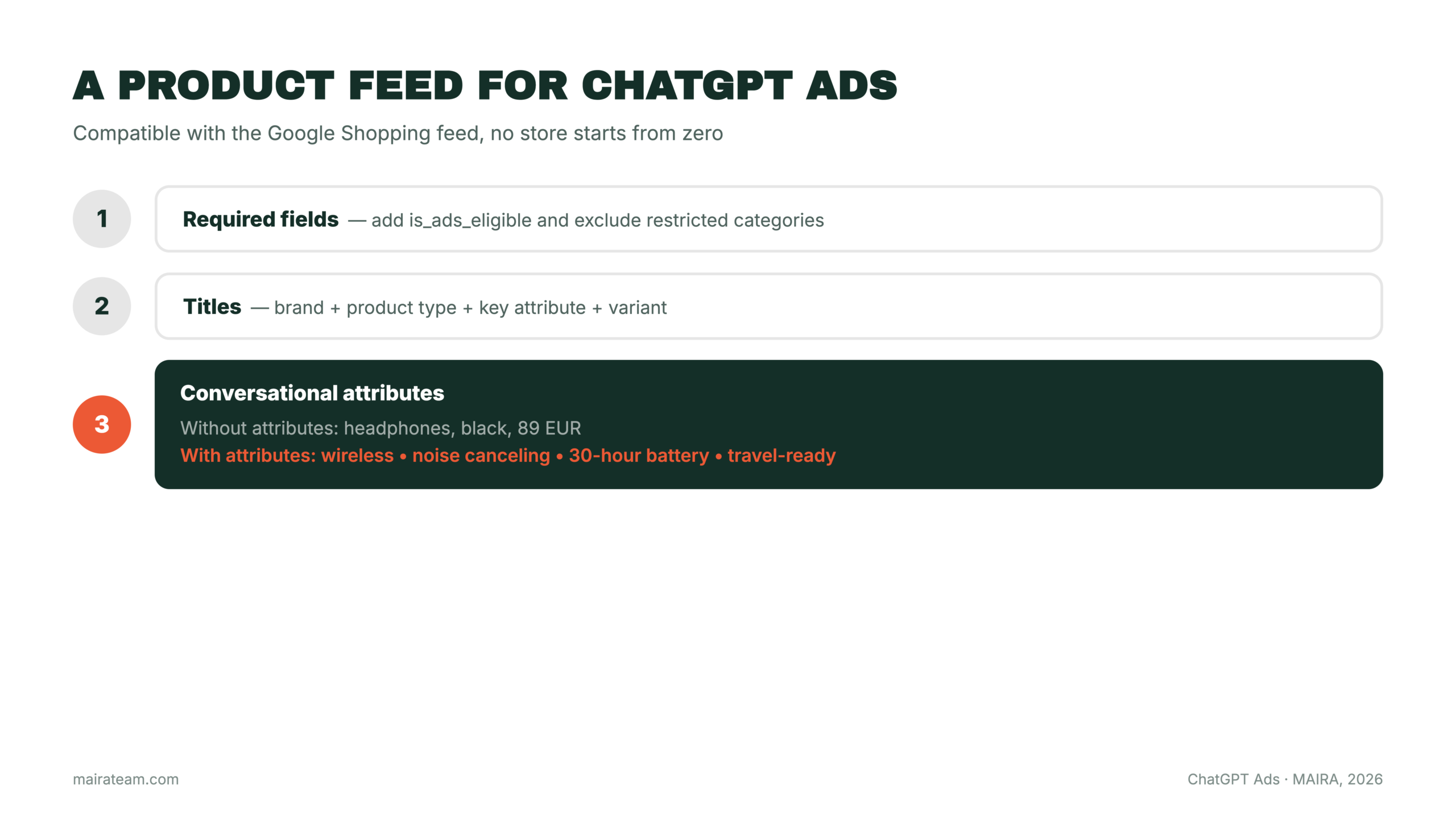
OpenAI's ads feed is built to be compatible with the Google Shopping feed, so no store starts from zero; your existing feed is the right starting point. Three steps:
- Format: add the extra required fields, above all is_ads_eligible, and exclude categories that cannot be advertised. Feed tools can automate the conversion from a Google feed.
- Titles: a shopping prompt in a conversation is written in natural language and runs longer than a search query. The title must carry what people actually choose by, not your internal product name. A proven formula: brand, product type, key attribute, variant.
- Conversational attributes: the extra information that gets a product recommended for questions a catalog description would never win. Without attributes, a feed says "headphones, black, 89 EUR". With attributes it also says: wireless, noise canceling, 30-hour battery, great for travel. Suddenly the product surfaces for "which headphones for long flights".
If you sell across markets, the feed work multiplies by language. Localized titles and attributes decide whether you surface for a Dutch or a German shopping prompt. We cover market-by-market feed localization in our EU expansion playbook.
What about creative and copy?
The visual is not a banner. It is a small square thumbnail next to the text, around 100 px on a phone. Design it like an app icon: one product or one clear motif on a plain background, high contrast, no text in the image.
| Element | Recommendation |
|---|---|
| Image | 1:1 square, upload high resolution (1200 x 1200 px), design for the small size |
| Headline | Up to 50 characters, truncates much earlier on mobile; lead with what matters |
| Description | Up to 100 characters, roughly half stays visible |
| Text in the image | None, nobody reads it at thumbnail size |
| Link | Final URL with UTM parameters to separate paid from organic traffic |
Treat the limits as provisional. The platform is young and OpenAI has updated its ad policies several times within the first half year.
What does it cost and what do early numbers show?
You pay per click in an auction. Clicks run in the low single-digit dollars, the minimum daily budget depends on the account currency and there are no minimum commitments. Beyond CPC, the platform also supports CPM buying and conversion optimization. That is a dramatic shift: the February US pilot started at a 200,000 USD minimum spend; today there is no minimum at all and tens of thousands of marketers have already advertised on the platform. As of August 31, 2026, OpenAI reports a 1 billion USD annual run rate for its ads business, alongside CPC, CPM, conversion optimization and the automated Maximize results bidding (OpenAI, August 2026).
Early public numbers are unofficial and contradictory. Click-through rates tend to sit below paid search because users often continue the conversation instead of clicking. There are first case studies with positive returns and there are critical tests showing weak relevance of delivery. OpenAI publishes no official benchmarks.
Our conclusion is simple: in 2026, ChatGPT Ads is a test channel. It deserves a separate budget, criteria agreed upfront and evaluation over months, not weeks. What early advertisers get is a cheap auction and a data head start, not guaranteed returns.
How do ChatGPT ads compare to other AI channels?
Perplexity shut down its advertising experiment in February 2026, which leaves ChatGPT as the only major conversational AI platform with its own self-serve ad product (Search Engine Land, 2026).
| Platform | Ad status | Buying |
|---|---|---|
| ChatGPT (OpenAI) | Sponsored cards in conversations, EU since 8/2026 | OpenAI Ads Manager |
| Google AI Mode and AI Overviews | Ads inside AI answers in Search | Google Ads, no separate buy |
| Microsoft Copilot | Ads served automatically | Microsoft Advertising |
| Perplexity | Ads discontinued in February 2026 | Not available |
Paid placement is only half of AI visibility. The other half is organic: getting ChatGPT, Gemini or Copilot to recommend your brand without a paid card. That discipline is called GEO and it is what our AI Visibility service covers; for e-commerce specifics, start with our e-commerce marketing overview.
FAQ
When can European companies start advertising?
Right away. Ads have been shown to users in 31 European countries since August 24, 2026, and since August 31, 2026, the self-serve OpenAI Ads Manager has been open to advertisers across Europe. You create the account yourself and go through business verification, which can take a few days, so measurement and feed preparation should run in parallel.
How much do ChatGPT ads cost?
You pay per click in an auction, typically low single-digit dollars per click. There are no minimum commitments; the minimum daily budget depends on the account currency. Beyond CPC there is also CPM buying and conversion optimization. Your real cost per conversion will only come from your own test; official benchmarks do not exist.
Do ChatGPT ads work outside e-commerce?
Yes. Only online stores need a product feed. Lead-driven businesses run the text card with a link and measure key site actions: form submissions, inquiries, registrations.
Do ads influence ChatGPT's answers?
No. The sponsored card renders separately below the answer and always carries the Sponsored label. You cannot buy your way into the answer itself; organic recommendations are the domain of GEO.
Can I see which conversations triggered my ads?
No. The Ads Manager reports impressions, clicks, spend and conversions, but not the conversations behind them. There is no search terms report equivalent, which is the biggest weakness in evaluation today.
Should I move budget from Google Ads into ChatGPT?
No. ChatGPT Ads should run from a separate test budget, not from working performance campaigns. The auction is new, data is only starting to accumulate and a test shorter than a few months proves nothing.
Conclusion
ChatGPT ads are the first real chance to buy a place in the conversation where a customer makes up their mind. They are also the youngest major ad channel on the market: no historical benchmarks, limited transparency and an auction still finding its level. The right approach is thorough preparation (account, measurement, feed, signals) and a test budget you can afford to lose, run for the data head start it buys you.
Want to be early into ChatGPT ads without burning the budget? We set up the account, measurement and feed, and run the first campaigns. Talk to our ChatGPT Ads agency.

Jan Křelina
PPC Specialist
At MAIRA I handle PPC and Meta advertising for our clients across Europe. I love it when I see positive results of my work and when I manage to take my client’s online marketing one step further. I love learning new things and platforms and I’m really enjoying the combination of PPC advertising and AI agents. In my spare time I like to travel, watch TV series or unwind at a spa.