Conversational Attributes in Google Merchant Center
Conversational attributes in Google Merchant Center: 6 new feed attributes built for AI shopping. What they contain, how to deploy them, why to move first.

Six attributes that teach AI to sell your products
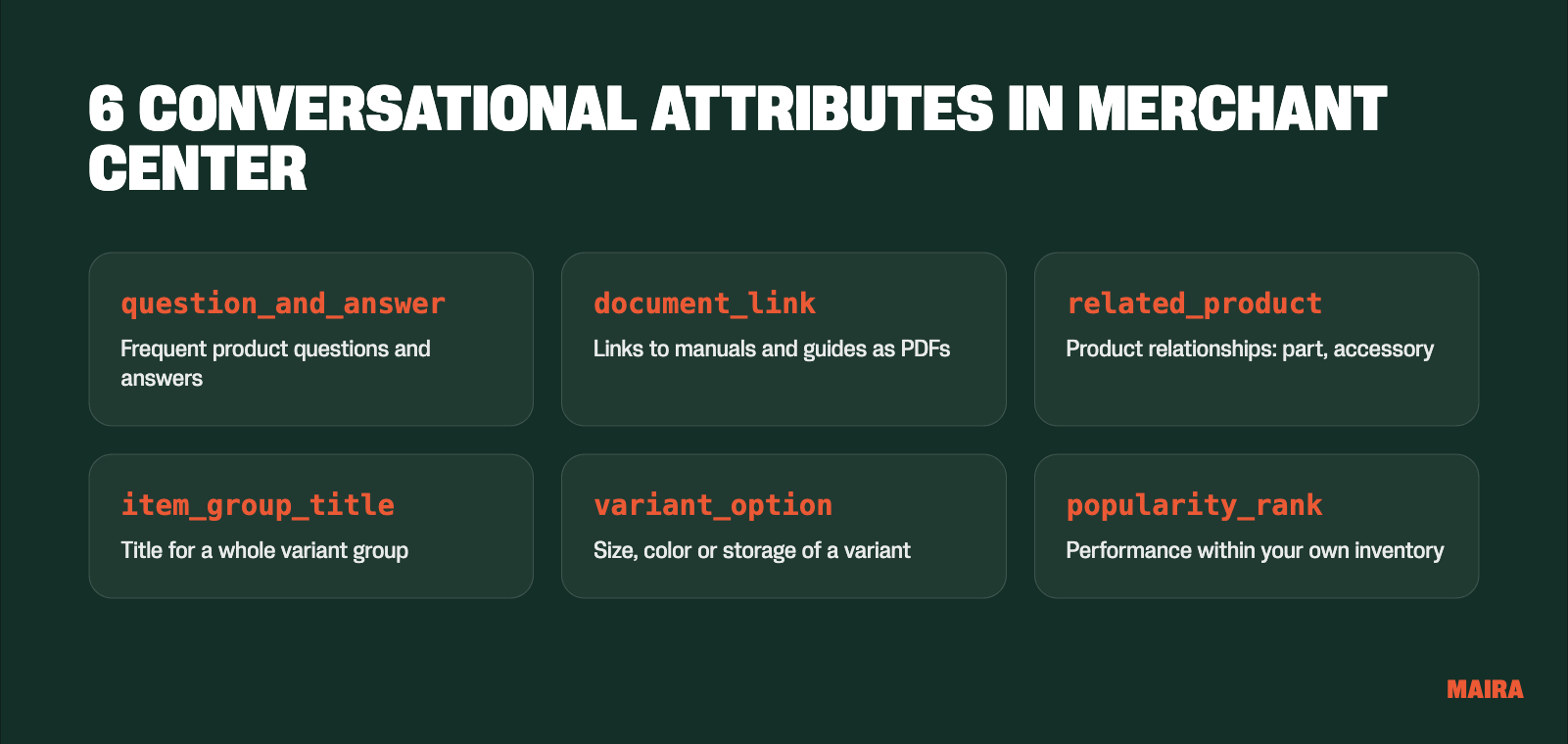
Conversational attributes are six new optional attributes in Google Merchant Center: question_and_answer, document_link, related_product, item_group_title, variant_option, and popularity_rank. They help AI systems like AI Mode in Search understand product nuances and answer conversational shopping queries. Deploy them via a supplemental data source; they do not affect the approval status of existing products.
to deploy all six attributes via a supplemental data source
better conversion from AI-referred traffic (Semrush/Similarweb, 2026)
more AI visibility for content with sourced statistics (Princeton, KDD 2024)
SKUs we manage in client feeds across 30+ markets
Shoppers no longer type "bluetooth headphones". They ask "which headphones under 100 euros have a headphone jack and 40 hours of battery?". A classic feed with title, price, and description cannot answer that. Google's response is a new attribute set in Merchant Center built specifically for conversational and agent-driven shopping. This is one of the first practitioner guides to the topic: what each attribute contains, how to deploy the set, and why filling it in before your competitors is the cheapest first-mover play in ecommerce right now.
What are conversational attributes in Google Merchant Center?
Conversational attributes are optional product feed attributes Google introduced for AI shopping surfaces. They enrich standard product data with the information shoppers ask about in conversation: frequently asked questions, manuals, product relationships, variants, and popularity. Google uses them on AI-driven surfaces such as AI Mode in Search (Google Merchant Center Help, 17085370, 2026).
Key properties of the whole set:
- Completely optional. Skipping them breaks nothing. Filling them in risks nothing.
- No impact on approval status. Adding the attributes does not interfere with approval of your existing products.
- Not a replacement for existing data. Google explicitly says: do not duplicate content from the description, product_highlight, and product_detail attributes.
- Built for conversational queries. They answer "does it, will it fit, what goes with it", not "what is it".
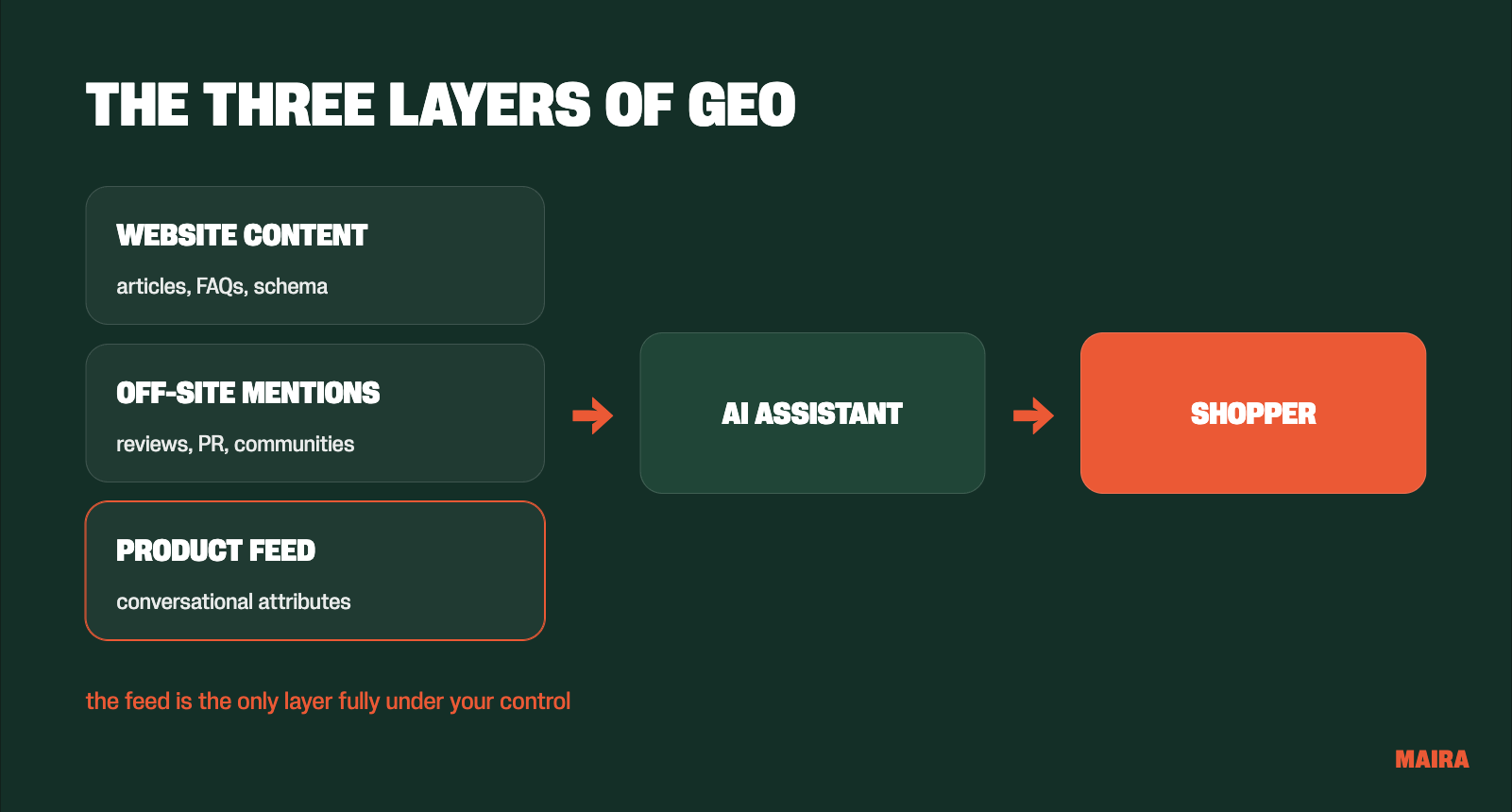
If GEO covers optimizing website content for AI answers, conversational attributes do the same job for product data. Call it feed-side GEO: you optimize the source AI systems read your catalog from.
Why is Google introducing these attributes?
Because shopping behavior is changing faster than feeds are. AI Mode in Search, Gemini, and shopping agents answer compound conversational queries, and they need structured facts, not marketing copy. Conversational attributes give merchants a controlled channel to push those facts into AI systems.
The data says this game is worth playing now:
Traffic referred by AI assistants converts 4.4x to 23x better than regular organic traffic (Semrush/Similarweb, 2026).
Content with statistics and cited sources gains 30 to 41 percent more visibility in AI answers (Princeton/GaTech, KDD 2024). The same logic applies to product data: the more specific and structured the facts, the more likely AI recommends your product.
And the field is wide open: 73 percent of brands ranking on page one of Google still have zero AI mentions (research, 07/2026). For European merchants selling on Zalando, OTTO, or bol.com alongside their own stores, the feed is the one surface they fully control. Whoever structures it for AI first gets recommended first.
Which 6 attributes can you fill in?
The set contains six attributes: question_and_answer, document_link, related_product, item_group_title, variant_option, and popularity_rank. Each one covers a different type of conversational query, from "does it have a headphone jack?" to "which cable do I need with this?" to "which variant sells best?".
| Attribute | What it contains | Format | Example |
|---|---|---|---|
| question_and_answer | product FAQs | question:answer pairs | "Does it have a headphone jack?":"This version doesn't have a headphone jack." |
| document_link | links to PDF documents (manuals, assembly guides) | URLs, comma-separated for multiple files | https://shop.com/manual.pdf, https://shop.com/assembly.pdf |
| related_product | relationships between products | relationship_type:identifier_type:identifier | accessory:gtin:811571013579 |
| item_group_title | title for a whole variant group | text, paired with item_group_id | Organic Cotton Men's T-Shirt |
| variant_option | what distinguishes a variant (size, color, storage) | name:value pairs | size:8,color:moonstone |
| popularity_rank | product performance within your own inventory | numeric, higher = better | 95.5 |
Source: Google Merchant Center Help, answer 17085370, 2026.
Three practitioner notes:
- related_product supports required_part, accessory, and often_bought_with relationships. That is exactly what an agent needs when a shopper says "add everything I need to use this".
- item_group_title and variant_option belong together with item_group_id. They let AI understand that 12 feed items are one product in 6 colors and 2 sizes, and recommend the right variant instead of a random one.
- popularity_rank is an internal signal: how a product performs within your own catalog. AI can lean on it when a shopper asks for "your most popular model".
How do you deploy conversational attributes?
The easiest path, and the one Google recommends, is a supplemental data source. You create a table with product IDs and the new attributes, and Merchant Center joins it with your primary feed. The primary feed stays untouched, so nothing can break. The alternatives are adding the attributes directly to the primary feed or using the Merchant API.
| Deployment path | Best for | Pros | Cons |
|---|---|---|---|
| supplemental data source (recommended) | most merchants | no changes to the primary feed, fast start, easy testing | one more data source to maintain |
| primary feed | merchants with full control over feed generation | everything in one place | touches the production feed, needs development |
| Merchant API | large catalogs, frequent updates | automation, near real-time updates | requires developers |
Step-by-step via a supplemental data source:
- Pick your products. Start with bestsellers and high-margin items, not the whole catalog.
- Collect the content. Questions from customer support tickets, reviews, and on-site Q&A, links to manuals, accessory and variant data.
- Build the table. The id column must match the IDs in your primary feed; the remaining columns are the individual attributes.
- Upload it in Merchant Center. Data sources, add supplemental source, link it to the primary feed.
- Check processing. Verify in diagnostics that the attributes loaded without errors.
- Keep it fresh. Add new support questions monthly and recalculate popularity_rank from sales data.
One warning: conversational attributes will not save a feed with broken GTINs, wrong categories, or stale availability. Fix baseline data quality first, then add the conversational layer.
What should go into the attributes, and what should not?
Fill the attributes with facts shoppers actually verify before buying and that are not already in your product description. Keep out marketing phrases, duplicates, and guesses. AI systems work with facts, and inconsistent data damages the credibility of your entire feed.
What works:
- Real questions from support. Your support inbox is the goldmine: questions that arrive repeatedly are exactly what AI will ask on shoppers' behalf.
- Compatibility and dimensions. "Fits into", "works with", "requires". The most common conversational queries in electronics, furniture, and DIY.
- Manuals and assembly guides as PDFs. AI can pull answers to detailed technical questions that would never fit in a feed field.
- Honest product relationships. Use required_part only where the part is genuinely required. An agent that recommends an unnecessary purchase damages your brand, not Google's.
What to avoid:
- Duplication. Do not repeat content from description, product_highlight, or product_detail. Google explicitly discourages it.
- Unsupported superlatives. "Best on the market" answers nothing. "42-hour battery life measured at 50 percent volume" does.
- Dead links. A broken document_link is worse than none.
- Inflated popularity_rank. It should reflect real sales data. If every product gets 99, the signal is worthless.
How do conversational attributes fit a GEO strategy?
Conversational attributes are feed-side GEO: the third pillar of AI visibility next to website content and off-site mentions. Content convinces AI assistants to cite your pages, mentions build trust in the brand, and the feed decides whether AI recommends a specific product. Merchants who cover all three layers win the whole shopping journey.
| GEO layer | What you optimize | Tools |
|---|---|---|
| website content | articles, FAQs, comparisons, page structure | answer-first structure, schema, tables |
| off-site mentions | brand citations on third-party sites | digital PR, communities, reviews |
| product data (feed-side GEO) | machine-readable product facts | Merchant Center, conversational attributes, Product schema |
Roughly 85 percent of the brand mentions LLMs rely on originate on third-party websites (research, 07/2026). The feed is different: it is the only layer where you have full control over the data and where the first-mover advantage kicks in the day you deploy.
At MAIRA we manage feeds with more than 14 million SKUs across 30+ markets, so we know conversational data cannot be manual work at scale: Q&A pairs can be generated from support and review data, product relationships from sales data.
FAQ
What are conversational attributes in Google Merchant Center?
A set of six optional product feed attributes: question_and_answer, document_link, related_product, item_group_title, variant_option, and popularity_rank. They help AI systems such as AI Mode in Search understand product details and answer conversational shopping queries. You deploy them via a supplemental data source, the primary feed, or the Merchant API.
Will adding the attributes affect my product approval status?
No. Google explicitly states that conversational attributes do not interfere with the approval status of existing products. They are fully optional and carry no disapproval risk. The safest route is a supplemental data source, which leaves your primary feed untouched.
Do I have to fill in all six attributes?
No. Start where the impact is highest: question_and_answer on bestsellers (the questions already sit in your support data) and variant_option with item_group_title on products with variants. Add document_link and related_product where you have manuals and clear product relationships.
How are conversational attributes different from product_detail?
product_detail describes technical parameters (material, dimensions, performance) in structured form. Conversational attributes cover what parameters cannot: questions and answers, documents, relationships to other products, and popularity. Google explicitly asks merchants not to duplicate content between the two.
Do the attributes help in classic Google Shopping too?
Google positions them primarily as support for AI-driven surfaces such as AI Mode in Search. The documentation does not promise direct impact on classic Shopping campaigns. Better product data has historically helped across surfaces, though, so filling them in makes sense beyond AI scenarios.
How much does deployment cost and how long does it take?
For a store with an existing feed, days rather than months. A supplemental data source is a table with product IDs and new columns uploaded to Merchant Center. The real work is content: collecting support questions, manual links, and product relationship data.
Is it worth it if AI Mode shopping has not reached my market yet?
Yes, that is the point. Deployment takes days, while the first-mover advantage grows with every AI shopping rollout across Europe. The data you prepare now is the same data shopping agents will read. Waiting has no upside; deploying has no risk.
Conclusion
Conversational attributes are the cheapest first-mover opportunity in ecommerce in 2026: six attributes, a supplemental data source deployed in days, zero approval risk, and a direct line to AI Mode and shopping agents. While your competitors wait to see how it plays out, your products can start answering shoppers' questions today. Want to know how ready your feed is for AI shopping? Grab your free audit.

Jan Křelina
PPC Specialist
At Proficio I handle PPC and META advertising for our clients across Europe. I love it when I see positive results of my work and when I manage to take my client’s online marketing one step further. I love learning new things and platforms and I’m really enjoying the combination of PPC advertising and AI agents. In my spare time I like to travel, watch soap operas or hole up in the spa.